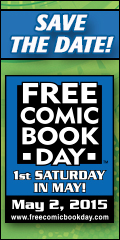
On Free Comic Book Day, held the first Saturday in May, special issues are given away as an incentive to bring fans and would-be fans into local comics stores. Sponsors include comics publishers.
It's classic case of sampling, a sales promotion designed to increase short-term interest and start customers on the path toward long-term loyalty. Customers get comic books for free--but then, to keep following the stories and the characters, they have to buy the next issues. And that's how future fans are born.
Comic Book Day is very social, with 600,000+ Facebook fans, 41,000 Twitter followers, and a YouTube presence. The official site has a convenient store locator. In some areas, if you can't make it to a store, you can participate online (as shown in this UK online promotion).
In addition, Comic Book Day is using traditional media to help local shops attract customers. Check local newspapers and you're likely to see an article about the new comics or an ad by a local shop promoting this giveaway. Who wouldn't want to be among the first to see a new Doctor Who comic with three doctors?!
Marketing analysis, opinion, and links by Marian Burk Wood, author of Pearson Education's "The Marketing Plan Handbook."
Showing posts with label freemium. Show all posts
Saturday, April 25, 2015
Wednesday, March 6, 2013
The Pros and Cons of Freemium
"Freemium games . . . are an almost unique case where companies can price-discriminate down to the level of the individual consumer."
This is the view of Ben Holmes, who recently wrote a piece for the Wall Street Journal about the economics of freemium games. His point is that customers who try a game (or another product) without any risk or outlay can then decide what extras, if any, they're willing to buy. This means individual customers determine how much they want to invest in special characters or props or levels, after trying the game for free. Many will decide not to pay anything, but those who do want to continue will pay willingly for extras because they've discovered the value for themselves.
This freemium approach to pricing is paying off for some marketers. Evernote (which makes software for organizing notes and data) said in mid-2012 that consumer acceptance of paying for the premium version takes time. After the first year, only 1% of its customers were converting from the free version to a paid version. After the second year, however, 12% were using a paid version.
Fast-forward to 2013: Evernote now says 6% of customers are converting to the premium version. In other words, as it attracts more users and builds buzz, more people recognize the value and pay for the upgrade. As Evernote's CEO says: "The easiest way to get one million people paying is to get one billion people using."
Not everyone favors freemium. "The freemium business model certainly has its place, but getting the conversation about money out of the way up front allows your company to focus on user experience," writes Andrew Flachner in a different (also recent) Wall Street Journal piece. He says that customers who perceive the value from day one will be willing to open their wallets and, as a result, will be more committed to using the product.
When USA Today reviewed Real Racing 3, a freemium game from Electronic Arts, it complained about being "nickel-and-dimed" with "a freemium model that makes gamers cough up money often or wait it out." Here, the point is that a really good game should be able to attract paying customers rather than frustrating users with intermittent payment options.
Will freemium become more popular as a pricing strategy?
This is the view of Ben Holmes, who recently wrote a piece for the Wall Street Journal about the economics of freemium games. His point is that customers who try a game (or another product) without any risk or outlay can then decide what extras, if any, they're willing to buy. This means individual customers determine how much they want to invest in special characters or props or levels, after trying the game for free. Many will decide not to pay anything, but those who do want to continue will pay willingly for extras because they've discovered the value for themselves.
This freemium approach to pricing is paying off for some marketers. Evernote (which makes software for organizing notes and data) said in mid-2012 that consumer acceptance of paying for the premium version takes time. After the first year, only 1% of its customers were converting from the free version to a paid version. After the second year, however, 12% were using a paid version.
Fast-forward to 2013: Evernote now says 6% of customers are converting to the premium version. In other words, as it attracts more users and builds buzz, more people recognize the value and pay for the upgrade. As Evernote's CEO says: "The easiest way to get one million people paying is to get one billion people using."
Not everyone favors freemium. "The freemium business model certainly has its place, but getting the conversation about money out of the way up front allows your company to focus on user experience," writes Andrew Flachner in a different (also recent) Wall Street Journal piece. He says that customers who perceive the value from day one will be willing to open their wallets and, as a result, will be more committed to using the product.
When USA Today reviewed Real Racing 3, a freemium game from Electronic Arts, it complained about being "nickel-and-dimed" with "a freemium model that makes gamers cough up money often or wait it out." Here, the point is that a really good game should be able to attract paying customers rather than frustrating users with intermittent payment options.
Will freemium become more popular as a pricing strategy?
Saturday, January 23, 2010
Fremium Pricing
Thanks to freemium pricing--giving products away for free--authors can gain visibility (and bragging rights) when their books, priced at $0, rise to the top of the Kindle best-seller list. This also helps raise the perceived utility of expensive e-book readers, which are popular among early adopters but have yet to move into the mainstream.
Giving away a product to increase its perceived value seems counterintuitive. However, the freemium movement--at work in the apps world, in music, and in other industries--suggests that this strategy is effective in a surprising number of situations.
Not everyone is a freemium fan, as "Why freemium is bad for business" explains. I agree with many of the points in that article . . . especially the part about there being no such thing as a free lunch.
Still, the point of freemium pricing is to demonstrate the product's value and encourage users to upgrade to a better version that carries a real price tag. And the Kindle freemium book strategy appears to be doing just that.
Giving away a product to increase its perceived value seems counterintuitive. However, the freemium movement--at work in the apps world, in music, and in other industries--suggests that this strategy is effective in a surprising number of situations.
Not everyone is a freemium fan, as "Why freemium is bad for business" explains. I agree with many of the points in that article . . . especially the part about there being no such thing as a free lunch.
Still, the point of freemium pricing is to demonstrate the product's value and encourage users to upgrade to a better version that carries a real price tag. And the Kindle freemium book strategy appears to be doing just that.