With 20 million visitors every year, Macy's sprawling Herald Square flagship store is a massive (2 million + square feet) retail location. Fifty years ago, this venerable store carried anything and everything a growing New York City family might need. Today, US department stores no longer stock fabric by the yard, needlepoint supplies, or paint-by-number hobby sets, but back then, Macy's had it all and a lot of choices--at a variety of price points from bargain-basement to couture-level!
Now this 34th Street flagship has emerged from a multiyear makeover, shined up, modernized, and remerchandised with an eye toward local/tourist shoppers. This is worth blogging about, because it represents the way merchandising was accomplished before computers.
Decades ago, buyers had offices in the main store and roamed the aisles to observe shopper behavior and ask questions about preferences. With input from department managers, merchandise managers, and store managers, the buyers would then tailor each branch's inventory allotment to the needs and buying patterns of shoppers in the local area. In this case, Macy's flagship is a tourist magnet, attracting shoppers from all over the planet. Therefore, Macy's must consider local shoppers (mid-career men and women, Millennials, families, etc) and the tastes of tourists from Europe, the Americas, Asia, and beyond. In fact, Macy's welcomes international shoppers by hosting a tourist bureau on its mezzanine level and offering a discount to shoppers who show a foreign passport.
Given the sheer size of the Macy's retail empire (nearly $28 billion in annual revenue derived from Macy's and Bloomingdale's stores), localizing merchandising is no small feat. This competitive effort has been going on since 2008, a way to distinguish Macy's from rivals and make the Macy's name represent a meaningful advantage in each local market. But the benefits outweigh the challenges, as the company understands. Having the appropriate mix of brands and products, in sizes and styles that fit local or tourist shoppers, will satisfy shoppers from near and far--and help Macy's top line and bottom line. Not to mention all the digital marketing initiatives undertaken by Macy's in recent years.
Marketing analysis, opinion, and links by Marian Burk Wood, author of Pearson Education's "The Marketing Plan Handbook."
Showing posts with label local marketing. Show all posts
Wednesday, November 19, 2014
Tuesday, February 19, 2013
Retail marketing's strong local flavor
"If we came to Canada and didn't offer ketchup-flavored potato chips,
then we would have looked like we didn't know what we are doing," says the head of Target Canada. In other words, the U.S. company behind the red bulls-eye logo can't simply add a maple leaf and use Canadian spelling to impress shoppers as it readies its new store openings.
Customers can tell at a glance whether a retailer understands what they prefer. If locally-produced or locally-popular products are featured on store shelves, if cold-weather products are available in northern states during winter, those are signs that the retailer is paying special attention to customer behavior on a store-by-store basis. By tailoring the merchandise assortment to local needs, retailers can compete more effectively and boost sales/profits. This approach also sends a signal that the retailer is committed to understanding the local community.
Local merchandising is nothing new--but national chains are still rediscovering its marketing power. Walmart, Walgreens, Trader Joe's and others are playing up local interests and local favorites with signage, displays, and special events that appeal to local shoppers. Macy's is involving its employees in the effort to tailor merchandising and service to local preferences.
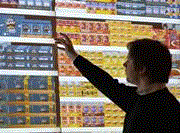
In the UK, Tesco has adopted virtual merchandising as a way to see, at a glance, what store shelves would look like with certain products and a certain number of facings for each product, category, and brand (see photo at right).
The system allows Tesco's marketers to rearrange shelf displays for different stores, and also overlay data about sales velocity or profits as an input to decisions about what goes where. What should be placed at eye level, what should be placed on the top shelf, what should be placed at the bottom? This system helps its marketers decide.
Customers can tell at a glance whether a retailer understands what they prefer. If locally-produced or locally-popular products are featured on store shelves, if cold-weather products are available in northern states during winter, those are signs that the retailer is paying special attention to customer behavior on a store-by-store basis. By tailoring the merchandise assortment to local needs, retailers can compete more effectively and boost sales/profits. This approach also sends a signal that the retailer is committed to understanding the local community.
Local merchandising is nothing new--but national chains are still rediscovering its marketing power. Walmart, Walgreens, Trader Joe's and others are playing up local interests and local favorites with signage, displays, and special events that appeal to local shoppers. Macy's is involving its employees in the effort to tailor merchandising and service to local preferences.
The system allows Tesco's marketers to rearrange shelf displays for different stores, and also overlay data about sales velocity or profits as an input to decisions about what goes where. What should be placed at eye level, what should be placed on the top shelf, what should be placed at the bottom? This system helps its marketers decide.
Wednesday, February 23, 2011
Marketing a Small/Local Business: Thrifty-Plow
Being located in a snow-belt area, I'm a prime customer for driveway plow services. These tend to be owner-operated and hyper-local.
Because this has been one of the snowiest winters on record in my area, plow services have been overloaded with work. To get and keep customers, any plow service must emphasize personalized marketing and reliable service delivery. This is the story of one local business that gets it right.
Earlier this month, I received the newsletter (top) from Bruce, the owner of Thrifty-Plow, who has been clearing my driveway for the past 3 years. Because the current bill (below) was so much higher than usual, Bruce wrote a lengthy explanation of why and how he changed his services to cope with the unprecedented wintery mess.
Now why is this smart marketing? First, Bruce prepared his customers for the big shock of the biggest bills he's ever sent us. He reminded us of the conditions he (and we) faced in clearing driveways, explained in detail how he did a good job despite the major obstacles. He described the scope of his services and what he must do to be sure the job is complete--and closed with a reminder that his rates are as low as he can make them.
The bill, handwritten, detailed every service Bruce provided so customers could figure out what he did and what he charged for each service. Then, because my driveway is among the last to be plowed, Bruce applied a 20% discount "for waiting."
Smart marketing: Even the bill reinforced the value that Bruce provided for the money I pay. Although Bruce had to spend extra time plowing the extraordinary snowfall, he included my discount to show that I received extra value because I'm his customer.
Bruce didn't need colorful materials or flashy logos to get or keep my business. Bruce has no Facebook page, no Twitter feed. I don't care whether his bill is hand-written or computer-generated. In fact, I wrote him a thank-you note along with my check. He keeps the "brand promise" of Thrifty-Plow: He always gets the job done at a reasonable price.
Because this has been one of the snowiest winters on record in my area, plow services have been overloaded with work. To get and keep customers, any plow service must emphasize personalized marketing and reliable service delivery. This is the story of one local business that gets it right.
Earlier this month, I received the newsletter (top) from Bruce, the owner of Thrifty-Plow, who has been clearing my driveway for the past 3 years. Because the current bill (below) was so much higher than usual, Bruce wrote a lengthy explanation of why and how he changed his services to cope with the unprecedented wintery mess.
Now why is this smart marketing? First, Bruce prepared his customers for the big shock of the biggest bills he's ever sent us. He reminded us of the conditions he (and we) faced in clearing driveways, explained in detail how he did a good job despite the major obstacles. He described the scope of his services and what he must do to be sure the job is complete--and closed with a reminder that his rates are as low as he can make them.
The bill, handwritten, detailed every service Bruce provided so customers could figure out what he did and what he charged for each service. Then, because my driveway is among the last to be plowed, Bruce applied a 20% discount "for waiting."
Smart marketing: Even the bill reinforced the value that Bruce provided for the money I pay. Although Bruce had to spend extra time plowing the extraordinary snowfall, he included my discount to show that I received extra value because I'm his customer.
Bruce didn't need colorful materials or flashy logos to get or keep my business. Bruce has no Facebook page, no Twitter feed. I don't care whether his bill is hand-written or computer-generated. In fact, I wrote him a thank-you note along with my check. He keeps the "brand promise" of Thrifty-Plow: He always gets the job done at a reasonable price.
Saturday, February 27, 2010
Hyper-local Marketing
Many friends and neighbors are already Netflix subscribers but others watch movies on premium cable or DirecTV. Plus AT&T's U-verse is expanding into my area. The result: lots of competition and lots of offers. Netflix knows to fish where the fishing is good.
Remember, the market for such services is mature; therefore, acquiring new customers generally means persuading consumers to switch from a competitor. Hyper-local marketing is helping these companies reach out to potential switchers in towns where intense competition has heightened awareness of the many options available. It also helps companies target prospects that resemble current customers (via demographics including geography and via psychographic segmentation).
Too often, national advertisers ignore the targeting possibilities of community newspapers. Yet weekly papers (especially those with paid circulation) can be very good vehicles for reaching consumers who are involved with and connected to their communities. Netflix is smart to take advantage of an underutilized medium in my area.