Showing posts with label profit margins. Show all posts

Thursday, April 26, 2018

Ford Steers Toward SUVs, Crossovers, and Trucks

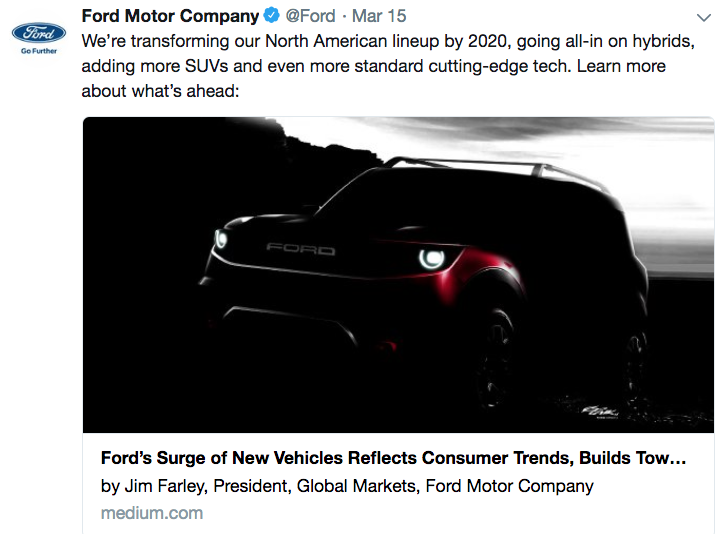
Now that oil prices have been well below $100/barrel for an extended period, Ford Motor Co. says it's cutting back on its line of passenger cars because of much higher demand for larger vehicles--which deliver higher profits.

As the tweet above indicates, Ford is "transforming our North American lineup by 2020..." The transformation means that U.S. dealers will soon sell only two passenger-type vehicles: the Mustang and the Focus Active (a forthcoming crossover).

The rest of the vehicles in Ford showrooms will be SUVs, trucks, and crossovers. So is Ford speeding away from passenger cars? Not really. The head of global markets says: "We will have a very diverse passenger car business. It just won’t be traditional silhouetted sedans that tend to be commoditized."

In other words, Ford is busy reinventing vehicles with a remix of benefits and design for the next generation of car buyers, resulting in distinctive products that are differentiated from competitive vehicles. The company is also slashing costs to improve profitability. Because the smaller cars don't deliver as much profitability as the larger vehicles, they're being dropped from the product mix.

By 2022, Ford's dealerships in North America will stock none of these models: Fiesta, Focus, and Taurus. The phaseouts will follow the company's product lifecycle schedule. Remember that Ford's marketing in the rest of the world will continue to feature passenger cars that are fuel efficient and fit the driving preferences of local buyers.

Wednesday, January 17, 2018

Nestlé and Ferrero Shape Up US Product Portfolios

Nestlé USA, whose parent company is based in Switzerland, just announced the sale of its U.S. candy products to Ferrero. Included are the familiar brands shown above.

Not included are the iconic Toll House products and even more iconic KitKat chocolate products. Interestingly, Nestlé doesn't make or market the KitKat bars you buy in U.S. markets--those are made and marketed by Hershey.

This acquisition puts Ferrero into the number-three slot among US candy marketers, behind Mars and Hershey. Ferrero has actually been on a buying spree, picking up Ferrara Candy and Fannie May in 2017. Ferrero already owns well-known brands like Nutella and TicTac, marketed for decades and popular with loyal customers. 

Both Nestlé and Ferrero view their product portfolios from a global perspective. What sells well and where? Where and why are products not just popular but profitable? And what are the long-term prospects for growth? Nestlé is reshaping its portfolio as it sets profit goals and examines consumption and buying trends. Ferrero is looking ahead to production expansion and technological innovation being drivers of sustainable growth. 

Wednesday, December 6, 2017

McDonald's Serves Up Value (Again)

Did you know McDonald's rings up $25 billion in annual sales? That's "billions and billions" of burgers, fries, soft drinks, Egg McMuffins, and other popular menu items sold every year.

In fact, its "all day breakfast" initiative has helped turn around the fast-food giant's sales momentum.

But value remains a key element in the consumer's perception of fast-casual food. And that's why McDonald's is planning to rev up its value menu--again. This time, only a few items are priced at $1, with other special deals at $2, $3, and $5. Not to mention the "Extra Value Meal Deals" that bundle a sandwich and a beverage and a side for customers morning, noon, and night.

The idea is to attract price-conscious fast-food fans and preserve some of the profit margin. And have more weapons in the price war with competing fast-food chains.

What's more, McDonald's is putting coffee front and center with hot and cold, tall and short offerings, targeting coffee-lovers of all ages and all value perceptions. A recent Snap "disappearing coffee" bitmoji is an example of engaging content created especially for a younger targeted segment, for instance.

With more than 75 million Facebook likes, 3.5 million Twitter followers, and 2.8 million Instagram followers, plus a presence on Tumblr and YouTube, McDonald's has a gigantic social media audience. The fast-food giant is leveraging this reach to encourage more visits, stimulate product trial, and reinforce brand loyalty.

Tuesday, September 19, 2017

New Marketing for Plus Size Fashions

Some sponsors of CurvyCon 2017
At CurvyCon, a recent fashion-week event featuring plus-size women's fashions, the CEO of plus-size fashion subscription firm Dia & Co observed: "We are so far away from true size inclusivity when it comes to fashion." In the words of entrepreneur CeCe Olisa, "if every brand carried every size, then we wouldn’t have to specify plus-size or not." CurvyCon attracted a lot of sponsors eager to reach this target market, estimated at $21 billion--and growing quickly.

It's a new marketing era for "plus size" amid rebranding to avoid negative connotations and signal a better understanding of consumer behavior in this target market. For example, after listening to customer feedback, women's clothing in larger sizes at Kmart will now be marketed as "fabulously sized."


More fashions for this market are on the way. PVH, which counts Calvin Klein among its brands, has recognized the profit potential in plus, and is marketing a new line of plus-sized lingerie. PVH recently acquired True & Co, which is established in the plus lingerie business.

A growing number of online marketers are targeting plus women, from ModCloth to EShakti and Eloquii. ModCloth's CEO notes: "There’s this belief that plus-size customers simply don’t spend as much — but that is only because of a lack of choice." His firm's research found that this target market would spend more if fashions in their sizes were available. And they tend to shop more frequently, another plus for plus size marketing.


Wednesday, August 24, 2016

Marketing Private Brands

Private brands--also known as private-label--are created or owned by retailers and other channel intermediaries.

Supermarkets are heavily into private brands, as are many general merchandise retailers like JC Penney (which owns Arizona, shown at right). Why? Because these are exclusive to the store and, just as important, they have higher profit margins.

Twenty years ago, an article in the Harvard Business Review said:
... private-label strength generally varies with economic conditions. That is, private-label market share generally goes up when the economy is suffering and down in stronger economic periods.
Today, however, the economy is strengthening and so are private brands. For example:
  • Kohl's is seeking a turnaround based on private brands such as Sonoma, Croft & Barrow, and others that are or have been mainstays of its revenue base. However, how will this resonate with shoppers seeking well-known national brands?
  • JC Penney is also putting more emphasis on private brands such as St. John's Bay and Arizona as it seeks a turnaround. In 2015, private brands accounted for 52% of Penney's sales--but by 2019, the marketing goal is to have private brands contribute 70% of Penney's sales.
  • Target wants shoppers to prefer its private-label food products, marketed under brands such as Market Pantry and Simply Balanced.
Private brands are here to stay. The question is, how much emphasis is too much emphasis?

Monday, November 2, 2015

Competitors as Stakeholders: Look at the Airline Industry

In my long-running series discussing the fact that competitors are stakeholders, this post looks at what happens to the airline industry when competitors make major changes.

The four largest carriers in the U.S. airline industry (an oligopoly because of the relatively few carriers who compete) are the target of a Department of Justice probe over "capacity discipline." Translation: Are American, Delta, Southwest, and United working together -- illegally -- to constrain expansion, which has the effect of increasing the pricing power of the airlines and therefore keeping up healthy profits? 

In the airline industry, "adding capacity" can lead to profit-sapping price wars as airline carriers seek to fill more seats by slashing prices to attract passengers (who in some cases might otherwise fly a different airline). During the Great Recession that followed the financial turmoil of 2008, most airlines found themselves with excess capacity as business and vacation travelers alike reduced their travel budgets. So for economic reasons, the carriers restricted capacity individually and, in that way, kept costs like fuel and payroll under control.

Clearly, if and when Southwest or American Airlines or another major airline adds flights, its competitors need to pay close attention. In fact, American's CEO recently said that although lower fuel costs are improving profit margins and can support more capacity, his airline won't aggressively add capacity in the near future. So America is maintaining capacity discipline on its own.

Yet Southwest Airlines CEO Gary Kelly said during an interview  that he's sticking to his plans to increase capacity: "Our competitors are always complaining about Southwest, and we're just going to continue to focus on running a great airline…" Not maintaining capacity discipline, in other words, which will inevitably affect the marketing strategies of other major competitors.


Meanwhile, airlines are looking at ways to increase productivity by increasing the number of seats crammed into every aircraft. This would boost per-flight profitability, but would be likely to decrease passenger satisfaction.

Wednesday, November 5, 2014

What's the Role of Stamp Marketing?

The U.S. Postal Service is working hard to come up to marketing speed. It needs revenue, and it provides direct-to-door delivery at a competitive price. In fact, given the price of postage around the world, U.S. first-class stamps are a relative bargain.

Now the USPS is being criticized for, well, marketing. Specifically, for issuing stamps with particular commercial value, rather than mere commemorative value. In part, the point is to encourage purchasing and in part, to encourage a revival in stamp collecting among a new generation.

In the bottom row left, the Batman stamp that has been a lightning rod for criticism because it represents an ongoing partnership with Warner Bros. and DC Entertainment. In limited edition, it was released at New York Comic Con. Commercial? Definitely, as was a Harry Potter stamp series and other pop-culture stamps.

In the top row right, the Rudolph stamp for 2014. Issued 50 years after the animated Rudolph special hit TV screens, the stamp evokes nostalgia with a commercial angle--and has provoked comments like this one from a former Postmaster General, quoted in Bloomberg Businessweek: "They have really ruined the stamp program. They have prostituted it in an effort to make money."

What is the role of stamp marketing? One former member of the committee that sifts stamp ideas and recommends subjects says the USPS should avoid issuing stamps "with the same profit motives as Big Macs, Slurpees, jeans or neighborhood tattoo parlors."

Given the financial situation of the USPS, stamp marketing must take profitability into account. Yet tradition has a definite place: Last year, the USPS issued a new version of the "Inverted Jenny," a stamp famous for the airplane (the Jenny) being mistakenly printed upside down. The originals are rare and celebrated.

Issuing a new version was more than a way to stimulate purchasing: It also put a smile on the faces of ordinary buyers and collectors alike, because of the back story and the decades of history involved in the Jenny mistake. Reinforcing a positive attitude is certainly a valuable role for stamp marketing.

Thursday, July 24, 2014

Unintended Consequences of Loss-Leader Pricing

Staples, the office-supply superstore, used loss-leader pricing to gain New York State as a customer for a three-year period.

To seal the deal, Staples said it would price 219 commonly-purchased office supplies at just one penny each.

One penny for a paper shredder. One penny for a box of blackboard chalk. One penny for six dozen batteries.

What happened next shouldn't surprise any shopper who has gotten up at 4 a.m. to take advantage of a super bargain price on Black Friday.

Government agencies and organizations that qualify under the New York purchasing umbrella rushed to order the one-penny items. Not just one or two, but dozens. One school district in New York state ordered loads of merchandise, total value more than $677,000 at list price (admittedly higher than the usual selling price). The district paid........$299.15, according to a Wall Street Journal article.

Staples isn't the only firm to experience the unintended consequences of loss leaders. Many small businesses see Groupon's daily deal loss-leader as a high-profile way to introduce the business to new customers. But some that offered loss-leader deals through Groupon found themselves overwhelmed by orders that left little if any profit margin. The response far exceeded expectations and strained the business's ability to operate effectively and efficiently, an unintended consequence that soured some firms on the daily-deal pricing model.

Loss-leader pricing can be effective in many situations. Prince used it to launch an album in 2007--he essentially gave CDs away in partnership with a London newspaper, incurring a loss on the deal. But the buzz over this giveaway helped Prince sell out 21 live shows in London, netting the performer a hefty profit. The newspaper saw a bounce from its involvement, as well.

Loss-leader pricing can be excellent for attracting attention, driving publicity and word-of-mouth, and increasing traffic, either to a website or to a retail location. Marketers need to link pricing to overall marketing strategy and understand how the program will affect short- and long-term customer loyalty as well as ongoing profitability.

Tuesday, October 8, 2013

Texas Is Pickup and SUV Country

Bloomberg Businessweek just published this graphic showing where new car sales are strongest--and of course Texas is a hot spot. Yes, North Dakota and Alaska have more registrations, but there's no question that Texas is pickup and SUV country.

The Texas State Fair, which runs for another 12 days, features a dedicated auto show and larger-than-life displays to catch the eye. With 300,000 square feet of auto exhibits, there really is something for everyone. Check out the listings of exhibitors in these photos from the fair's site. Texas-sized marketing!


The state is such an important market that Ford chose it as the location for a media sneak peek of its 2015 F-Series Super-Duty King Ranch Truck. Ford sells a new F-series pickup in Texas every 42 seconds.

GM builds a number of SUVs in Texas, including Chevy Suburban and the Tahoe, among others. Having signed on as the state fair's official sponsor, Chevy gets top billing and some Texas-sized bragging rights.

Toyota is in Texas, too, announcing it produced its 1 millionth truck in its local plant. The new Toyota Tundra comes in a special 1794 edition named for the ranch where the plant is located. But Toyota still has a ways to go to catch up to Ford and GM in the Lone Star State.

Why are SUVs and trucks so important in the marketing scheme of things? They deliver big profits to automakers. So even though fuel-efficient vehicles are increasingly popular, SUVs and trucks boost revenues and profit margins, big-time.

Thursday, July 11, 2013

King.com's Freemium Strategy

The mobile/FB game Candy Crush Saga is exhibit one in making freemium pricing pay off. Freemium is a pricing technique in which customers get the basic offering for free with the option of paying for upgrades or additional functionality. Most apps are freemium-priced, and many mobile games.

The UK game company King.com is targeting women in the age group of 25 to 55 for Candy Crush, although others outside that demographic play, as well. You start by downloading the free version to see if you like it . . . and once you gain proficiency, you might want to pay a little for extra elements that will help you reach higher levels. The game itself is fun and deceptively easy, and the payments are small. 

This "sweet" game is played far and wide--about 600 million times every day, on iPhones or Android phones or Facebook. Nearly three-quarters of Candy Crush players use the free version. That means fewer than 30% pay to play--but those small payments add up.  Candy Crush reportedly earns King.com about half a million pounds ($750,000) every day. The profit margin is extremely healthy, needless to say.

Not everyone admires freemium pricing. Some people raise concerns about the effect on usage of more traditional digital games that must be purchased to be played. They also wonder whether game marketers are tweaking games to improve the odds that players will pay up. "Coercive monetization" is the term one economist applies to freemium pricing.

Yet the high-profile success of some app marketers makes a compelling case for investigating whether freemium can be used for other goods and services.

Wednesday, June 6, 2012

Whose Profit Margin Tops 60%?

Marketing pop quiz! Match the company with its approximate profit margin:

1. Tiffany
2. Mattel
3. Dell
4. Whole Foods Markets
5. Rovio

A. 21%
B. 30%
C. 50%
D. 57%
E. 64%

Answers:
 1-D, 2-C, 3-A, 4-B, 5-E
  • Dell's gross profit margin (computers, electronics) is a bit over 21%. 
  • Whole Foods Markets (food retailing) enjoys gross profit margins of more than 30%. 
  • Mattel's margin (toys) is a little over 50%. 
  • Tiffany's (jewelry) margins are higher than 57%.
  • Rovio's gross margin is so high because the Angry Birds parent company gets 30% of its $100 million in annual revenues from licensing and the rest mainly from game downloads. Looking ahead, can Rovio prove it's not a one-hit wonder?