Showing posts with label supply chain. Show all posts

Wednesday, June 30, 2021

The Pandemic's Impact on Business

Some of the big consulting firms are examining the past, present, and possible future impact of the COVID-19 pandemic on the business world.

Here's what they are thinking right now, in mid-2021:

  • McKinsey: Many countries will see higher GDP growth in 2021, with key consumer behavior trends (like shopping online for groceries) continuing into the future.
  • PWC: Global businesses surveyed said their crisis response management needs to be improved. 
  • KPMG: CEOs are using scenario planning to understand how vaccine shortages and timing might affect their personnel, key functional areas, and supply-chain management.
  • BCG: Business leaders are looking at hybrid working models with lessons learned from pandemic operations, and finding ways to adapt more quickly to crisis situations. 

Thursday, January 15, 2015

Target Says "Au Revoir, Canada"

Target had such high hopes for its Canada venture back in 2011, when it took over leases of dozens of defunct Zellers stores. Many Canadians were looking forward to a local Target shopping experience, having been in U.S. Target stores during trips to the States.

Alas, after investing billions of dollars to outfit, stock, staff, and promote 133 stores from coast to coast, Canada couldn't overcome its severe supply-chain problems and get the merchandise pricing optimal for local shoppers while delivering ROI for the parent company. The CEO says:
We were unable to find a realistic scenario that would get Target Canada to profitability until at least 2021.
So Target is saying goodbye to the northern markets when its Canada unit files for bankruptcy protection. By mid-2015, Target expects to have liquidated its Canadian holdings.

Monday, June 16, 2014

Big Data Marketing

Marketing is synonymous with Big Data marketing, says Professor Thomas Davenport of Babson College. Very good point. More than ever before, CIOs and CMOs are collaborating to make the most of data collected from every customer touchpoint and enhance/individualize the customer experience.

Big Data has the potential to improve nearly every aspect of marketing, which is why so many organizations are pouring money, time, and talent into developing such systems. But Big Data will only be a marketing boost if companies carefully analyze the teeny, tiny details and put them into proper context.

For example, Ford and its dealers found some interesting trends after implementing the company's Smart Inventory Management System--its Big Data project. They learned that buyers in South Bend, Indiana were particularly interested in trucks with green and gold features. That single data point wouldn't help Ford dealers anywhere else, because South Bend is the home of the University of Notre Dame, a green and gold school. Overall, the Big Data project is doing a great job of recommending what Ford dealers should order to meet customer demand--and making the supply chain more efficient and effective for everyone in the Ford ecosystem.

Finally, customers are understandably concerned about what Big Data means for privacy. If they are educated about the benefits, know how data will be used, and trust a brand, the majority of consumers will agree to data collection. The key is transparency.

Tuesday, May 27, 2014

Target Canada Targets Supply Chain Problems

Empty shelves? That's not the way to attract customers and build revenues, yet that's the unfortunate situation at too many of the Target's stores in Canada. Well known for its affordable, stylish products, Target has stumbled in its entry to the Canadian market.

Rather than begin with a few stores and expand gradually, Target acquired dozens of locations and launched a large-scale entry across the country. However, behind the scenes, the Minneapolis-based company was struggling with the physical distribution challenges of moving merchandise through its giant warehouses and into individual stores--and the equally daunting task of determining demand levels for merchandise in individual stores throughout Canada.

Merchandise was arriving at the warehouses, but the contents didn't always match what the electronic documentation said. Every box had to be verified by hand, a tedious and time-consuming task. As a result, store shelves were sparsely filled as merchandise piled up in the warehouses day after day after day.

In recent weeks, customers posted photos on social media and Canadian news outlets reported on the bare shelf situation, compared with fully-stocked shelves in U.S. Target stores. Just as bad are the news reports of Target Canada pricing some merchandise higher than the same merchandise in its U.S. stores, which the new Canadian head says he's prepared to address.

Now Target has decreed it will turn this situation around in 30 days. The brand started life in Canada with incredible goodwill because so many customers had shopped at U.S. stores for so long. This is a critical moment in its Canadian history and a lesson in the value of getting logistics just right. Of course, Target doesn't just have to get shelves stocked--it also has to learn what customers want in each local market and tweak its merchandise assortment accordingly.

Target is highly active in social media because its target market is tech-savvy and social. Target Canada has 1.2 million Facebook likes on its English page and more than 150,000 likes on its French-language page. Its Pinterest board has 170,000 followers. Another unique Target feature is its online mag, A Bullseye View, with fashion news, store innovations, new products, and more.

Target's mission statement "is to make Target your preferred shopping destination in all channels by delivering outstanding value, continuous innovation and exceptional guest experiences by consistently fulfilling our Expect More. Pay Less.® brand promise." It's working hard to turn that mission into reality by improving its supply chain and in-stock situation across Canada.

Wednesday, March 16, 2011

Infrastructure Is the New Frontier

The terrible situation in Japan has caused untold human suffering and loss of lives. As the government and industry leaders assess the damage, help survivors, and prepare to rebuild, it's clear that infrastructure repairs and improvements will be needed just to get started. In other words, infrastructure is the new frontier for Japan.

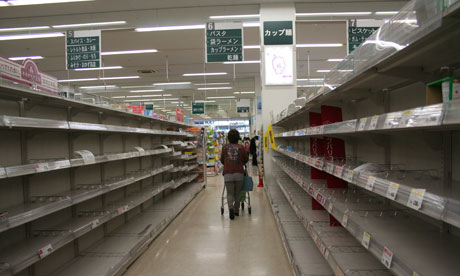
This nearly-empty supermarket is fast becoming the norm throughout Tokyo and surrounding areas. Most streets are dotted with tiny convenience stores that, in ordinary circumstances, would receive daily shipments of fresh foods and ready-to-eat entrees. Vending machines are outside every major train station and on many street corners, and these are usually replenished every couple of days. Now, with train service spotty, and gasoline supplies dwindling or gone, the supply chain can barely function. The result: empty shelves, empty vending machines. And for survivors in the Sendai area, where the tsunami hit, food is scarce despite relief efforts, in part because it's simply a challenge to transport anything into this region.

Electricity is being shut off in different areas of Tokyo for hours at a time, with no end in sight, to conserve power. Imagine the impact on refrigerated foods and medicines that must be kept chilled. Friends in Tokyo say that many businesspeople are staying in downtown hotels because they must be at work but they can't get home to the suburbs. Yet how long can hotels and restaurants stay open when supplies run out and power is turned on and off erratically? Many restaurants are small businesses, and without customers or supplies, their ability to keep going in the long term is obviously in question.

To help its people and rebuild its economy, Japan will have to tackle its infrastructure problems--and quickly. The ripple effect throughout the global marketplace is already being felt. Japanese factories are big suppliers of memory chips for smart phones and other devices. Marketers that depend on Japanese suppliers are being forced to buy from other sources, when they can, and with limited supplies, prices are rising (which means higher retail prices at the end of the channel). Popular electronics products are made in Japan (think Sony Blu-Ray for example) and those factories aren't back to normal quite yet.

Car manufacturers like Toyota that operate local factories are gearing up again following nearly a week at a standstill. But they, too, rely on their supply chain partners for parts and materials. And they need a consistent, reliable power supply to keep their assembly lines going. If gasoline isn't available, Toyota can't get the parts it needs and its cars won't sell in Japan, anyway, if buyers are trying to survive or have money to buy a car but can't get gas.

Infrastructure is Japan's new frontier. It will be very difficult, time-consuming, and costly to rebuild, but Japan has done it before--and it can and will do it again.