Showing posts with label CVS. Show all posts

Wednesday, September 3, 2014

CVS's Marketing Plan for Branding and Positioning

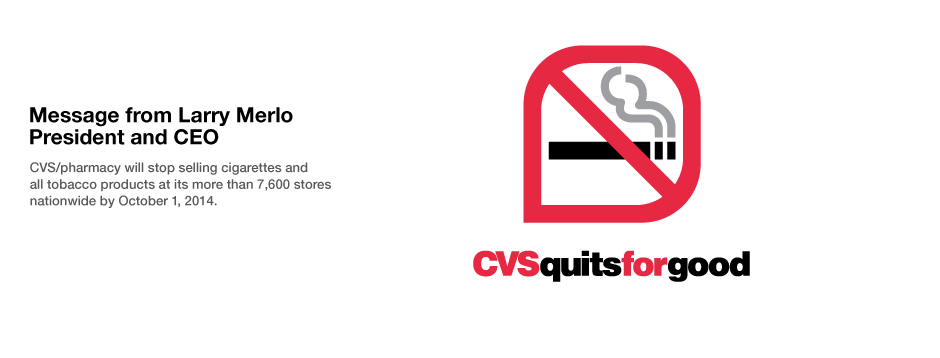
The drug-store chain CVS announced seven months ago that it would ban cigarette sales in its 7,600+ stores as of October. The goal is to strengthen the brand's positioning on the core benefit of helping consumers be healthy. 

As part of its marketing plan for branding and positioning, CVS began removing tobacco products from its stores today, a month ahead of schedule. This attracted a lot of media attention because the retailer also changed its company name to CVS Health and initiated a smoking cessation campaign. According to the CEO, "The contradiction of selling tobacco was becoming a growing obstacle to playing a bigger role in health care delivery."

The company is promoting the results of a new CVS study showing that removing tobacco products from its stores leads some percentage of shoppers to kick the smoking habit altogether.

Its marketing plan calls for opening hundreds of new MinuteClinic in-store health facilities within three years, bringing shoppers in when a child has an earache or for other minor medical needs. Positioning CVS as the go-to brand for health could also further enhance its ability to expand private-label products, which typically yield higher margins than non-store brands.

The CVS move to drop tobacco this week comes as the media world is gearing up for Stand Up to Cancer on Friday night, a nationwide entertainment industry initiative to raise money for cancer research.

Wednesday, February 5, 2014

CVS Drops Tobacco: A Lesson in Positioning

The classic definition of positioning is to create, via marketing, a competitively distinctive position for your brand or product in the mind of the target market. This concept is relatively new to marketing, having been introduced by Al Ries and Jack Trout in their 1980 book, Positioning: The Battle for Your Mind.

CVS's unexpected announcement that the drug retailer will stop selling cigarettes and other tobacco products by October is a classic example of positioning at work in the marketplace.

Take a look at CVS's competitive situation. It's battling two other major US chains, Walgreens and Rite-Aid. During the past year, Walgreens has used the slogan "At the corner of Happy and Healthy" in its advertising, website and social media. Rite-Aid's marketing focuses on its Wellness+ rewards program. In other words, both drug chains want consumers to associate them with health and wellness.

Now, with one announcement, CVS has positioned itself as the drug chain that is so concerned about consumer health that it is giving up the sale of tobacco products. CVS won't be sacrificing a huge amount of revenue (about $2 billion out of $123 billion or so), and tobacco is certainly not a growth product category.

Without jeopardizing a lot of money, CVS is generating a ton of free media coverage and goodwill for its principled stand. It already has 1.3 million Facebook likes, and I know the company's decision has been shared and tweeted many, many times since it was announced. (Some consumers are angry, but most appear to be applauding CVS.) One of its Twitter accounts has been posting messages thanking such groups as the American Diabetes Association for their public support.

Now when you think of CVS, what comes to mind? If your first thought is that the retailer has dumped tobacco, CVS has succeeded in positioning itself in a way that is meaningful, distinctive, and memorable. Giving up tobacco is a good thing for health and a good thing for positioning, too. Walgreens and Rite-Aid might even have to follow suit. Stay tuned.

Saturday, February 23, 2013

Changes in Store for In-Store Health Clinics?

Back in 2006, in-store health clinics were in their infancy. The idea of dropping by the local supermarket or discount store to have a nurse, physician's assistant, or doctor look at a sore throat was just getting established, but drug stores and chain retailers had ambitious plans. 

At the time, CVS had 70 MinuteClinics in stores coast to coast, and it bought MinuteClinic to drive rapid expansion. Walmart planned to open 2,000 clinics within a few years. Target had plans for multiple clinics, and other regional and national retailers were jumping on the clinic bandwagon. Their goal: broadening services by offering convenient access to health-care providers for common ailments like scrapes or sore throats, with the ability to fill prescriptions on-site if needed, all at a reasonable cost.

Of course, shoppers might just pick up a few other items before or after being seen at the in-store clinic, adding to the overall transaction size and profit potential. Especially in areas with limited access to everyday health care or few doctors, in-store clinics can fill the void.

Fast-forward to 2013: Walmart has fewer than 150 health clinics--far fewer than it projected. Overall, retailers are still refining their marketing of in-store health clinics. Walgreens, for example, is expanding its clinics on a market-by-market basis. A few years ago, CVS began shutting some Minute Clinics when seasonal demand was low, referring customers to nearby locations instead. As demand increases, it reopens individual locations to meet local needs.

Yet some surveys show that consumers remain interested in visiting clinics in stores and offices, seeking both convenience and affordability. In fact, new health-care legislation is likely to accelerate demand for in-store health clinics in the coming years

Meanwhile, retailers have been using the flu shot as a competitive tool, emphasizing flexible hours and availability. In the 2012-3 season, Rite-Aid offered a booklet of discount coupons worth $100 and CVS offered a 20% deal on all store purchases made during the flu shot visit. Walgreens has steadily promoted flu shots and is one of the country's largest providers of flu vaccinations, despite the recent vaccine shortage due to high demand. Walmart, Costco, Stop & Shop, and other retailers have featured flu shot signage and events to heighten awareness and draw customers in.

What other changes are in store for in-store health clinics?