Showing posts with label positioning. Show all posts

Saturday, February 11, 2017

Renting Clothing Is Still in Fashion

Back in 2009, Rent the Runway was in the vanguard of the clothing rental business model, offering designer-branded, special-occasion fashions at a fraction of the purchase price, to be worn for a few days and returned. Since then, it has expanded to stores and stores-within-stores at Neiman-Marcus. And gained competitors. And it offers a wider range of products like fashion accessories.

The rental/subscription model is increasingly popular as consumers avoid buying and instead, enjoy wearing in-style clothing for a limited time (a few days or a month). Of course, startups are looking for niches and differentiation so they can fine-tune an effective positioning.

For instance, Le Tote offers clothing by monthly subscription, selected by personal stylists for your consideration. Just check the "tote" to see what's being recommended, then rent, wear, return, and repeat. No shopping, no laundry, hundreds of styles/brands to choose from, and no unworn styles sitting in the back of your closet with the tags still on.

Interestingly, fashion brands that do business with these and other rental startups gain access to feedback that helps them better satisfy their customers, rental or purchase. Le Tote notes what happens to garments that are rented and returned, re-rented and returned. What parts wear out, for instance. And tells the manufacturers so they can do better. Win-win-win (for manufacturer, rental service, and--of course--the next customers.

Other product categories are represented in the rental-subscription business model, too. More on that soon,

Monday, August 8, 2016

Marketing Nordstrom in Canada: Customers First

Based in Seattle, the upscale fashion specialty store Nordstrom sums up its marketing purpose this way:
Since 1901, we've been committed to providing our customers with the best possible service—and to improving it every day. 
Nordstrom has three full-service locations in Canada and three more on the way. First to open will be the new store at Toronto Eaton Centre in September, followed by the new store in Yorkdale Shopping Centre.

At left, one of the ads paving the way for these full-service store openings. You First is the message, reinforcing Nordstrom's marketing positioning and a key point of differentiation.

Nordstrom has a well-deserved reputation for service--which will help it compete in the increasingly crowded Canadian retail market. The company is also opening additional Nordstrom Rack stores with off-price/discount merchandise, adding to its strength in relatively affordable fashion.

Tuesday, April 14, 2015

Positioning Shinola vs Apple

Positioning means using marketing to create a unique image or position for the product or brand in the minds of the target market. Positioning is a kind of short-hand that helps prospective buyers understand what the product or brand is all about and what makes it different from others in the same category. Differentiation is the name of the game in brand marketing, distinguishing a product from others in a way that is meaningful to buyers.

Sometimes a marketer positions a product as being similar to another product--and sometimes as being dissimilar to another product.

On the very day Apple announced that it would start accepting preorders for its much-anticipated Apple Watch, Detroit-based manufacturer Shinola positioned its analog watch against the Apple smart watch. The ad, shown at right, cleverly tells the entire positioning story in a single headline that also conveys Shinola's brand attitude:
A watch so smart that it can tell you the time just by looking at it.
Shinola placed its advertising in the New York Times, Wall Street Journal, and online on the company website. As long as the spotlight was on wristwatches, why not shine some of that light on the traditional analog watch that also happens to be hand-made in America? So Shinola's ad tells buyers a lot about the brand and the product by reminding them that this is not a new-fangled, feature-rich, bells-and-whistles kind of watch for the 21st century. No sirree.

For a glossary of marketing terminology, click here.

Wednesday, September 3, 2014

CVS's Marketing Plan for Branding and Positioning

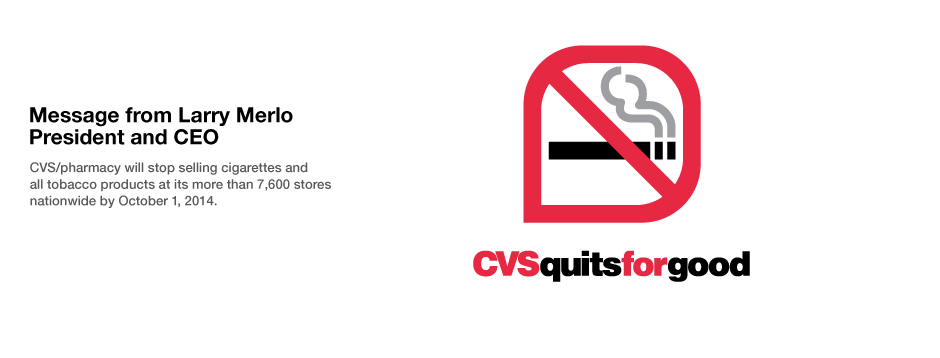
The drug-store chain CVS announced seven months ago that it would ban cigarette sales in its 7,600+ stores as of October. The goal is to strengthen the brand's positioning on the core benefit of helping consumers be healthy. 

As part of its marketing plan for branding and positioning, CVS began removing tobacco products from its stores today, a month ahead of schedule. This attracted a lot of media attention because the retailer also changed its company name to CVS Health and initiated a smoking cessation campaign. According to the CEO, "The contradiction of selling tobacco was becoming a growing obstacle to playing a bigger role in health care delivery."

The company is promoting the results of a new CVS study showing that removing tobacco products from its stores leads some percentage of shoppers to kick the smoking habit altogether.

Its marketing plan calls for opening hundreds of new MinuteClinic in-store health facilities within three years, bringing shoppers in when a child has an earache or for other minor medical needs. Positioning CVS as the go-to brand for health could also further enhance its ability to expand private-label products, which typically yield higher margins than non-store brands.

The CVS move to drop tobacco this week comes as the media world is gearing up for Stand Up to Cancer on Friday night, a nationwide entertainment industry initiative to raise money for cancer research.

Friday, June 20, 2014

Got Milk? Milk's Marketing Challenges: Consumer Behavior, Targeting, Positioning

The new tagline is "Milk Life"
Who can forget the iconic "Got Milk?" milk moustache ads of yesteryear? Celebs from all walks of life were featured, as you can see here. The goal was to encourage higher milk consumption through associations with health benefits and, of course, high-profile personalities. The campaign became a big hit and a pop culture touchstone.

After nearly 20 years, however, Got Milk? is no longer the national tagline for the Milk Processors. It's still in use in California, where it originated. But the new national tagline is "Milk Life," backed by a $50 million campaign. In fact, Milk Life already has its own FB page (with 451,000 likes) and its own hashtag (#milklife).

Whether the new campaign will reverse U.S. milk consumption trends is a big question mark. Americans drink a lot less milk today than they did in 1970, and the downward trend is especially pronounced for full-fat milk.
The chart above shows that today's Millennials are drinking much less milk, compared with U.S. teens and youngsters in the 1970s. Meanwhile, nichification has resulted in a dizzying array of milk variations and alternatives. One glance at the "milk section" of the supermarket will give you a hint at the many segments being targeted and the many products being offered. This is a consumer behavior issue as much as a targeting and positioning challenge.

On the other hand, milk consumption is going up in some nations. Not in the UK, where the downward trend is evident, but in many developing countries, including China.


Friday, May 16, 2014

Kellogg's Segments the Breakfast Market

Here's a rear view of the Kellogg's Corn Flakes cereal package currently on local store shelves. It features a promo for Kellogg's to Go products, including ready-to-drink breakfast shakes and ready-to-mix breakfast shake powder.

Kellogg's is battling to regain its momentum in an evolving market where packaged cereals continue to lose ground, a problem for the industry overall. Marketing on the basis of health and nutrition is helping some Kellogg products, including Raisin Bran, to hold their own. Still, many consumers see breakfast bars, smoothies, yogurts, and other items as more convenient and speedier to eat than sitting down to a big bowl of cereal and milk.

The CEO points out that a good-sized segment of the market craves protein--and milk (in cereal or a breakfast shake) can satisfy that need. Another segmentation variable is lifestyle. As a result, the company's "to go" product slogan is "Rise and shine. In no time." The positioning is fast and easy and nutritious (need-satisfaction/benefit orientation), just right for today's on-the-go lifestyle (lifestyle orientation).

Kellogg's uses marketing research to segment the consumer market for breakfast by understanding what people eat, when, where, with whom, and why/why not eat. "Segments created in this way often tend to be far more insightful than just clustering consumers or their needs," says Kellogg's director of insights and planning for Asia Pacific/S.S. Africa. What other breakfast segments and niches can the company identify and target to fuel future growth?


Monday, February 17, 2014

Ethnographic Research for Marketing

Genevieve Bell plays a vital role in Intel's long-term strategy and marketing plans. It's all about understanding people.

As director of user experience research, Bell and dozens of her researchers fan out across the planet to observe and question consumers about their use of tech gadgets, in everyday situations. She even has her own page and video on the Intel website.

Recently, Bell told the New York Times about her role at Intel:
My mandate at Intel has always been to bring the stories of everyone outside the building inside the building — and make them count. You have to understand people to build the next generation of technology.
Ethnographic marketing research is on the rise, as companies like Intel, Procter & Gamble, Whirlpool, Diageo, and Ford strive to learn much more about their consumers--what they actually do, what they actually like, how they actually use products at home or in out-of-home circumstances, and what motivates them to choose and use one product rather than another. Often, consumers can't identify, articulate, or accurately describe what they do or want--yet ethnographic researchers may identify important clues through observation and follow-up questions.

Ford hired ethnographic researchers in the 1990s to discover why consumers weren't connecting with the new Mustang's power and styling. Riding along with consumers, the researchers learned that drivers sensed a car's power in many ways, through feeling the engine's rumble, listening to its sound, and viewing the design as an elemental cue to power and speed.

Based on these insights, Ford redesigned the Mustang to effectively convey the positioning of power and speed. According to a Ford design executive: "This vehicle has that sense of motion, even when it’s standing still. It captures your eye from 50 feet away — it’s instantly recognizable as a Mustang."

Wednesday, February 5, 2014

CVS Drops Tobacco: A Lesson in Positioning

The classic definition of positioning is to create, via marketing, a competitively distinctive position for your brand or product in the mind of the target market. This concept is relatively new to marketing, having been introduced by Al Ries and Jack Trout in their 1980 book, Positioning: The Battle for Your Mind.

CVS's unexpected announcement that the drug retailer will stop selling cigarettes and other tobacco products by October is a classic example of positioning at work in the marketplace.

Take a look at CVS's competitive situation. It's battling two other major US chains, Walgreens and Rite-Aid. During the past year, Walgreens has used the slogan "At the corner of Happy and Healthy" in its advertising, website and social media. Rite-Aid's marketing focuses on its Wellness+ rewards program. In other words, both drug chains want consumers to associate them with health and wellness.

Now, with one announcement, CVS has positioned itself as the drug chain that is so concerned about consumer health that it is giving up the sale of tobacco products. CVS won't be sacrificing a huge amount of revenue (about $2 billion out of $123 billion or so), and tobacco is certainly not a growth product category.

Without jeopardizing a lot of money, CVS is generating a ton of free media coverage and goodwill for its principled stand. It already has 1.3 million Facebook likes, and I know the company's decision has been shared and tweeted many, many times since it was announced. (Some consumers are angry, but most appear to be applauding CVS.) One of its Twitter accounts has been posting messages thanking such groups as the American Diabetes Association for their public support.

Now when you think of CVS, what comes to mind? If your first thought is that the retailer has dumped tobacco, CVS has succeeded in positioning itself in a way that is meaningful, distinctive, and memorable. Giving up tobacco is a good thing for health and a good thing for positioning, too. Walgreens and Rite-Aid might even have to follow suit. Stay tuned.

Wednesday, October 2, 2013

Cinnabon's Sweet and Social Marketing Success

Above, the well-known Cinnabon Classic bun next to the Minibon. Counting sales in its franchised stores and through other channels, including branded buns in Burger King, Cinnabon sells 100 million cinnamon-infused sweet rolls every year and rings up $1 billion in global sales.

The brand positioning is as a sweet indulgence, not an everyday experience. Still, the caloric Cinnabon Classic (880 calories) is hugely popular, compared to the Minibon (350 calories). Cinnabon is also partnering with Pillsbury and Kellogg, among other big companies, on cobranded food products for supermarket shelves.

More growth and profits are in sight as Cinnabon expands into new markets like Libya and adds new franchise locations in existing markets. After all, with only 1,100 retail locations worldwide, there's lots of room for new stores.

The company is a hit in social media, with nearly 1 million Facebook friends, 48,000 Twitter followers, a YouTube page, a Flickr page, and quick responses to brand references in all media.

Coming up next: Cinnabon K-cup coffee pods from Green Mountain Roasters. What other cobranded products will Cinnabon explore?