What inspires Frito-Lay's snack flavors? The company is going to show us this week only, when its "Flavor Kitchen" campaign takes us into the kitchen for a sneak peek. The focus is on the all-natural ingredients that Frito-Lay is bringing to its product line.
See the Facebook page for a taste of the new campaign, streamed live during lunchtime hours from Monday to Friday. If you're in New York City, you can watch the events live on giant billboards in Times Square, as Frito-Lay's top chefs and celebrity chefs put on their aprons and get cooking. Media coverage will certainly multiply the effect of this fun multi-brand event, which also features Electrolux appliances.
Here's one of the demos:
Marketing analysis, opinion, and links by Marian Burk Wood, author of Pearson Education's "The Marketing Plan Handbook."
Wednesday, April 13, 2011
Tuesday, April 12, 2011
Goodbye to the Flip
Cisco announced this morning that it's ditching the Flip video cam business as part of its restructuring plan. The end of an era is here.
I'm a fan: I owned one of the original models, upgraded to HD, and have given several Flips as gifts -- yet I understand and agree with the marketing logic behind Cisco's decision.
- Consumer products aren't Cisco's strength or strategic focus. The Flip came to Cisco via its Pure Digital acquisition two years ago. Since then, Cisco has promoted its corporate name alongside the Flip product. But does the Flip help Cisco reinforce its image as a manufacturer of enterprise networking gear? No.
- Technology has moved on. Now that millions of consumers carry smartphones capable of recording video, who needs a standalone Flip?
- Competition has narrowed prices and margins. Cisco would be forever improving the Flip without adding much to its price, thanks to intense competition from rivals with strong consumer identities.
Monday, April 11, 2011
Brand Identity: Be Distinctive, Be Consistent
Martin Lindstrom writes in Fast Company about the need to think beyond the logo when communicating brand identity. Every aspect of the product, packaging, Web site, ads, etc. must be distinctive and contribute to creating and reinforcing a unique brand identity. Lindstrom suggests a wonderful test: Cover up the logo on your ads, packages, Web site, and see whether your brand identity still shines through.
With Easter coming up, I used Lindstrom's test on the Web sites of several well-known candy brands. Try it for yourself. First, go to M&M's home page. Take off the m and is it distinctive? (When I visited, the colors had been changed to Easter pastels, a nice seasonal touch.) Then visit the Hershey site, the Ghiradelli site, Godiva, Whitman's, and See's Candies.
Now try the same test on a few computer Web sites: Dell, Apple, Hewlett-Packard, Acer. Which are most distinctive and convey the brand identity most effectively?
It's difficult to look at any of these pages without thinking of the other marketing tactics used by these companies. The shape and design of an iPad2 (above) comes to mind, for example. That's a good thing, from a marketing perspective. But could you identify the Apple home page if the apple wasn't there?
With Easter coming up, I used Lindstrom's test on the Web sites of several well-known candy brands. Try it for yourself. First, go to M&M's home page. Take off the m and is it distinctive? (When I visited, the colors had been changed to Easter pastels, a nice seasonal touch.) Then visit the Hershey site, the Ghiradelli site, Godiva, Whitman's, and See's Candies.
Now try the same test on a few computer Web sites: Dell, Apple, Hewlett-Packard, Acer. Which are most distinctive and convey the brand identity most effectively?
It's difficult to look at any of these pages without thinking of the other marketing tactics used by these companies. The shape and design of an iPad2 (above) comes to mind, for example. That's a good thing, from a marketing perspective. But could you identify the Apple home page if the apple wasn't there?
Friday, April 8, 2011
ThinkGeek's "Gotcha"--Viral Marketing and Research
Did you see ThinkGeek's April Fool's products? If not, click here and browse this year's crop, along with the fun items made up for previous years. They're worth a few minutes of mousing around. You'll smile!
Online/catalog marketer ThinkGeek rings up serious profits from its $76 million in annual sales, and the company is growing like kudzu. On any day other than April 1st, its products range from the very practical to the highly whimsical, with descriptions written by some of the best copywriters in the business (IMHO).
This year's April Fool's products included the Playmobil Mini-Apple Store (Genius Bar shown above). As silly as these fake products may be, ThinkGeek gets a lot of mileage from its April Fool's pages. They're great for stirring up a storm of viral marketing and lots of free publicity as media outlets comment on the gag items.
Along the way, ThinkGeek throws in a little bit of marketing research. If you click to buy an April Fool's product, you're taken to a screen titled "Gotcha!" Right below, it asks the real question: "Want these products for real?! Let us know!" Check the boxes for any fake product you might be interested in, and leave your e-mail address. Who knows, ThinkGeek might just put Angry Birds Pork Rinds into production if enough people leave their e-mail addresses.
Actually, Wired's Gadget Lab blog notes that more than a few ThinkGeek prank products wind up as real after a few months. It's pushing for this year's Star Wars Lightsaber Popsicle kit to go on the market--by summer.
Online/catalog marketer ThinkGeek rings up serious profits from its $76 million in annual sales, and the company is growing like kudzu. On any day other than April 1st, its products range from the very practical to the highly whimsical, with descriptions written by some of the best copywriters in the business (IMHO).
This year's April Fool's products included the Playmobil Mini-Apple Store (Genius Bar shown above). As silly as these fake products may be, ThinkGeek gets a lot of mileage from its April Fool's pages. They're great for stirring up a storm of viral marketing and lots of free publicity as media outlets comment on the gag items.
Along the way, ThinkGeek throws in a little bit of marketing research. If you click to buy an April Fool's product, you're taken to a screen titled "Gotcha!" Right below, it asks the real question: "Want these products for real?! Let us know!" Check the boxes for any fake product you might be interested in, and leave your e-mail address. Who knows, ThinkGeek might just put Angry Birds Pork Rinds into production if enough people leave their e-mail addresses.
Actually, Wired's Gadget Lab blog notes that more than a few ThinkGeek prank products wind up as real after a few months. It's pushing for this year's Star Wars Lightsaber Popsicle kit to go on the market--by summer.
Thursday, April 7, 2011
Fitting Rooms: The "Last Mile" of Clothing Retailers
The last mile usually refers to the final connection between a telecom firm and its customers. It's been a challenge for all kinds of marketers trying to complete the distribution link to the customer's door (or office).
Clothing stores have a different "last mile," IMHO: The fitting room. If a customer takes clothing into the fitting room, there's a much, much better chance she'll take it home (assuming it fits). So what happens in the fitting room can make or break the sale.
Online retailers (and some store retailers) are using technology to show customers how clothing will fit. The auction/retail site eBay has an app to let you see how sunglasses will look before you buy. Virtual fitting rooms take some of the risk out of buying online, but when the customer is in the store, the fitting room is the last mile.
However, most fitting rooms aren't known for their customer-friendly ambiance. Now that's changing as stores upgrade this vital connection in the last mile. Some are putting fitting rooms in more central locations, rather than tucked into a faraway corner. Some are enlarging individual rooms, adding furniture, changing lighting. Macy's has tested a virtual fitting room in the store (see above), which not only lets the shopper see the "fit" but allows friends to see and comment, too.
Clothing stores have a different "last mile," IMHO: The fitting room. If a customer takes clothing into the fitting room, there's a much, much better chance she'll take it home (assuming it fits). So what happens in the fitting room can make or break the sale.
Online retailers (and some store retailers) are using technology to show customers how clothing will fit. The auction/retail site eBay has an app to let you see how sunglasses will look before you buy. Virtual fitting rooms take some of the risk out of buying online, but when the customer is in the store, the fitting room is the last mile.
However, most fitting rooms aren't known for their customer-friendly ambiance. Now that's changing as stores upgrade this vital connection in the last mile. Some are putting fitting rooms in more central locations, rather than tucked into a faraway corner. Some are enlarging individual rooms, adding furniture, changing lighting. Macy's has tested a virtual fitting room in the store (see above), which not only lets the shopper see the "fit" but allows friends to see and comment, too.
Wednesday, April 6, 2011
Rolls Royce Speeds Along in Style
Forty years after its bankruptcy (due to overspending on aircraft engine development), the UK-based car and engine maker Rolls Royce is speeding along. Owned by BMW, Rolls is accelerating sales even faster than the recession is receding. Last year's sales were more than twice those of 2009, a trend that Rolls wants to build on for this year.
One reason is red-hot sales in China, where (no surprise) the brand is a major status symbol. In fact, China is now Rolls's second-largest market, after the U.S.
Another reason for Rolls's recent success is the Ghost, pictured here, an entry-level Rolls priced lower than the Phantom but with the quality, luxury, and elegance that brand fans expect.
Looking ahead, Rolls is going green with an electric Phantom--something its customers have not requested, but the company feels is necessary. In the short-term, Prince William and his bride, Kate Middleton, will be driven to their Westminster Abbey wedding in style in a Rolls. The biggest marketing budget in the world can't buy that kind of exposure!
One reason is red-hot sales in China, where (no surprise) the brand is a major status symbol. In fact, China is now Rolls's second-largest market, after the U.S.
Another reason for Rolls's recent success is the Ghost, pictured here, an entry-level Rolls priced lower than the Phantom but with the quality, luxury, and elegance that brand fans expect.
Looking ahead, Rolls is going green with an electric Phantom--something its customers have not requested, but the company feels is necessary. In the short-term, Prince William and his bride, Kate Middleton, will be driven to their Westminster Abbey wedding in style in a Rolls. The biggest marketing budget in the world can't buy that kind of exposure!
Thursday, March 31, 2011
Play Ball! Marketing Baseball's Opening Day
Today is Major League Baseball's opening day, with six games scheduled. The Giants, who won last year's World Series, will play the Dodgers. The Rangers, who lost to the Giants in the Series, open their season against the Red Sox tomorrow.
Topps, maker of baseball trading cards, is marketing a special "opening day" assortment. Sports Illustrated has an entire section on opening day predictions, opinions, players, and so forth.
For a business wrap-up of last year's season and a preview of this year's business possibilities, click over to Forbes. The Yankees (my hometown team) have already sold $3 million worth of tickets--at the league's highest prices, says Forbes, which predicts that the Yankees and Phillies will be tops in attendance in 2011.
You say you want a baseball app? Well, you've got lots of choices. Never miss a game or a score, even if you're hundreds of miles from the nearest stadium. Batter up!
For a business wrap-up of last year's season and a preview of this year's business possibilities, click over to Forbes. The Yankees (my hometown team) have already sold $3 million worth of tickets--at the league's highest prices, says Forbes, which predicts that the Yankees and Phillies will be tops in attendance in 2011.
You say you want a baseball app? Well, you've got lots of choices. Never miss a game or a score, even if you're hundreds of miles from the nearest stadium. Batter up!
Monday, March 28, 2011
QR Moves into the Mainstream
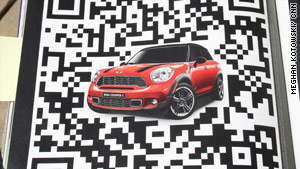
Quick--which catches your eye first, the QR code or the Mini-Cooper?
QR (quick response) codes are moving into the mainstream. Commonplace in Japan, they're new and intriguing for US consumers--and that's part of the appeal. All you need is a smartphone and an app to decode the QR and locate the material it points to. The puzzle and the feeling of being "in the know" are part of the experience.
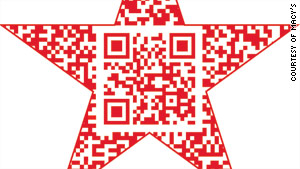
Macy's is using QR in its windows and in its stores, inducing customers to watch proprietary content such as videos showing celebrity designers at work. "It's one application that can speak to customers across so many vehicles," a Macy's exec told CNN. "QR codes are such a sensible way to send content with immediacy." Well said.
Home Depot is using QR to invite shoppers to check product reviews and do-it-yourself project guides while they're still in the store. This certainly boosts buyer confidence and reduces buyers' remorse.
QR codes on billboards are a growing trend. Point your smartphone or snap a photo and you can look up the info on your own schedule, interact with the brand at any time. Calvin Klein used QR to replace some racy billboards--now the content is "private" yet accessible via QR.
Where will QR pop up next?
(PS - I've included a QR pointing to my UK marketing blog, see left column)
QR (quick response) codes are moving into the mainstream. Commonplace in Japan, they're new and intriguing for US consumers--and that's part of the appeal. All you need is a smartphone and an app to decode the QR and locate the material it points to. The puzzle and the feeling of being "in the know" are part of the experience.
Macy's is using QR in its windows and in its stores, inducing customers to watch proprietary content such as videos showing celebrity designers at work. "It's one application that can speak to customers across so many vehicles," a Macy's exec told CNN. "QR codes are such a sensible way to send content with immediacy." Well said.
Home Depot is using QR to invite shoppers to check product reviews and do-it-yourself project guides while they're still in the store. This certainly boosts buyer confidence and reduces buyers' remorse.
QR codes on billboards are a growing trend. Point your smartphone or snap a photo and you can look up the info on your own schedule, interact with the brand at any time. Calvin Klein used QR to replace some racy billboards--now the content is "private" yet accessible via QR.
Where will QR pop up next?
(PS - I've included a QR pointing to my UK marketing blog, see left column)
Friday, March 25, 2011
Helping Customers Through a Crisis
The Japanese earthquake, tsunami, and nuclear problems have created an unprecedented crisis for people and businesses in Northern Japan. This is where customer service takes on new meaning. Any number of businesses have stepped up to help their customers through this terrible crisis.
For example, Otis Elevator immediately sent technicians into Northern Japan to make repairs and restore service to 16,400 of the 16,700 elevators that had seismic detectors and had automatically stopped operating until they were checked and cleared by the company.
Telecommunications firms offered free phone and text services to customers calling Japan. No word on how many customers took advantage, but the offer is thoughtful and helps ease anxieties of people who want to check on friends, family, and colleagues in Japan.
The public relations payback is a plus but the biggest benefit of helping customers through a crisis is reinforcing their loyalty. Customers have long memories. A company that gets them through a challenging period will earn their loyalty for a long time.
For example, Otis Elevator immediately sent technicians into Northern Japan to make repairs and restore service to 16,400 of the 16,700 elevators that had seismic detectors and had automatically stopped operating until they were checked and cleared by the company.
Telecommunications firms offered free phone and text services to customers calling Japan. No word on how many customers took advantage, but the offer is thoughtful and helps ease anxieties of people who want to check on friends, family, and colleagues in Japan.
The public relations payback is a plus but the biggest benefit of helping customers through a crisis is reinforcing their loyalty. Customers have long memories. A company that gets them through a challenging period will earn their loyalty for a long time.
Tuesday, March 22, 2011
The New Nostalgia Marketing
I can't resist saying that nostalgia marketing is nothing new. For years, it's been a fun and fairly effective strategy for reminding baby boomers of the "simpler times" of their childhood and young adult days.
Now Pepsi and other marketers are bringing nostalgia back for newer generations. MediaPost reports that Pepsi has, in fact, created an entire "throwback" team to manage nostalgia marketing targeting the Millennials, who were born digital and--like their baby-boom parents--are attracted to reminders of their youth. Luden's cough drops--a staple of 1950s childhood--are making a comeback with throwback packaging and graphics that link to the past but speak of authenticity today. Heinz is going retro, too.
Wisely, many of these retro marketing touches are limited-edition. Change is good--especially for Millennials, who often crave variety and novelty.
On the plus side of nostalgia marketing:
Now Pepsi and other marketers are bringing nostalgia back for newer generations. MediaPost reports that Pepsi has, in fact, created an entire "throwback" team to manage nostalgia marketing targeting the Millennials, who were born digital and--like their baby-boom parents--are attracted to reminders of their youth. Luden's cough drops--a staple of 1950s childhood--are making a comeback with throwback packaging and graphics that link to the past but speak of authenticity today. Heinz is going retro, too.
Wisely, many of these retro marketing touches are limited-edition. Change is good--especially for Millennials, who often crave variety and novelty.
On the plus side of nostalgia marketing:
- Packaging stands out in a crowded marketplace. No one can mistake the "throwback" Mountain Dew with new-fangled fruit-flavored fizzes, etc.
- Heritage gives a brand the authenticity that come-lately brands can't match.
- Being old enough to go "nostalgia" gives brands a wider range of possible marketing approaches based on previously successful campaigns.
- Overdoing the retro feeling until consumers think the brand has "jumped the shark."
- Not backing the brand promise up with real benefits that satisfy contemporary buyers' needs.
- Too many changes can confuse consumers and drive them back into the arms of brands that look familiar.