Showing posts with label brand value. Show all posts

Monday, June 5, 2017

Brand Purpose Boosts Unilever Brand Growth

https://twitter.com/Unilever
Some Unilever brands have been emphasizing sustainability and social responsibility initiatives--driving much higher revenue growth for those brands.

Unilever says those purpose-driven brands (including Ben & Jerry's, Lifebuoy, and Dove) are increasing revenue more than 50% faster than its other brands...and helping Unilever continue growing in the global marketplace.

Given the highly competitive nature of the product categories involved (such as ice cream and personal care), Unilever's experience indicates that consumers definitely recognize and respond to differentiation on the basis of non-functional benefits. In other words, many consumers will choose brands because of corporate citizenship and purpose, not just features that deliver benefits.

Yet brand purpose must also go hand-in-hand with brand usefulness, meaning the brand provides value in the form of meeting a consumer need.

Wednesday, March 1, 2017

Ranking Top Brands

Who's #1?

No two brand rankings are alike, which is why sometimes Apple is the world's top brand, sometimes Google, sometimes another brand. Year to year, the exact brand rankings can change, but usually the same group of well-known brands stays in the top tier.

Here are three brand rankings published during the past year:

  • According to Forbes, Apple is the world's most valuable brand, followed by Google, Microsoft, Coke, and Facebook.  (published 2016)
  • According to Interbrand, Apple is the world's best brand followed by Google, Coke, Microsoft, and Toyota. (published 2016)
  • According to Brand Finance, Google is the world's most valuable brand, followed by Apple, Amazon, AT&T, and Microsoft. (published 2017)
Even the very top brands like Google actively integrate their names and logos into entertainment viewed by millions. Google Earth played a pivotal role in the movie Lion, for example, showcasing its functionality and features. Apple is a perennial placement favorite in movies, too. Keeping a high profile adds to the image and the value of brand equity.

Sunday, May 29, 2016

Brand Rankings in 2016

So many ways to rank brands! Some authorities rank on the basis of brand value, some on the basis of performance, and on and on. In Fortune's recent listing of world's most admired companies, the top three were well-known US brands:

  1. Apple
  2. Alphabet (you know, Google's parent)
  3. Amazon


Here's a selection of how other sites rank US brands of various sorts.
  • Consumer Reports ranks vehicles here.
  • US News & World Report ranks vehicles in four categories (cars, trucks, SUVs, luxury) here.
  • Kelly Blue Book ranks car brands on the basis of image and value here.
  • Laptop magazine ranks the top laptop computers here.

Thursday, December 4, 2014

Hello Kitty's $7 Billion Brand

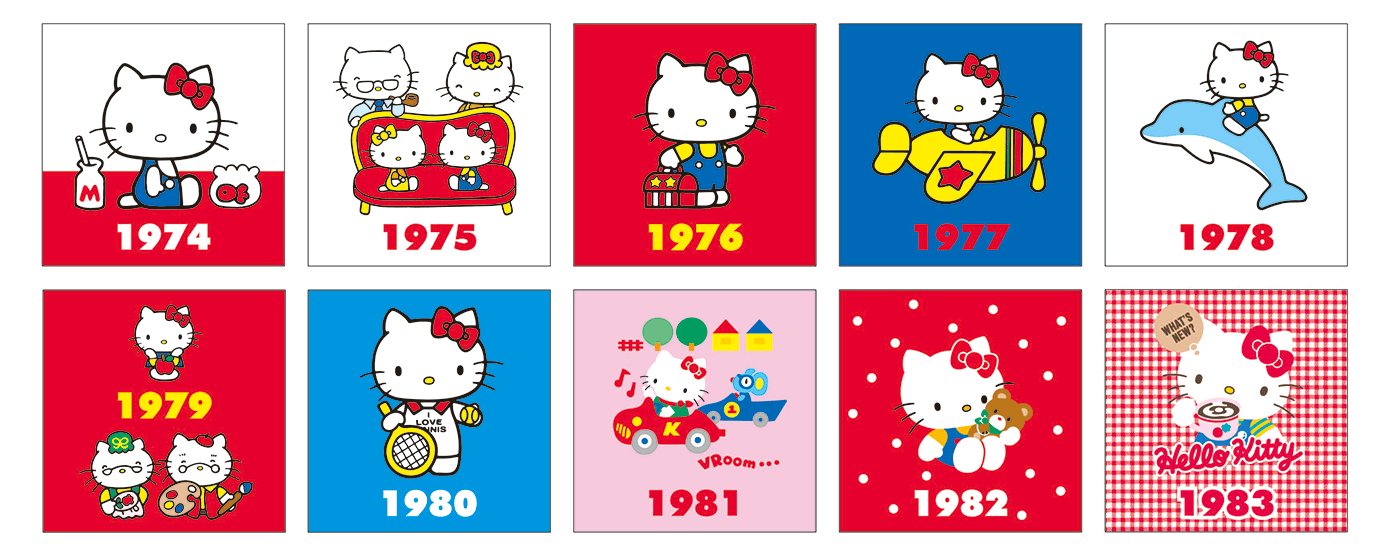
Happy 40th birthday, Hello Kitty. The iconic Japanese character, owned by Sanrio, has been making fans smile since 1974. Sanrio created her after consumer surveys revealed the perennial popularity of cats and dogs (and bears). The company already had a bear character and was licensing Snoopy, so it developed Hello Kitty and a star was born.

Hello Kitty is licensed for a wide variety of products worldwide. She's also the feature attraction in a new Hello Kitty theme park, soon to open in Zhejiang province, China. Hello Kitty has other theme parks in other places (including in her home country of Japan and in Malaysia), to entertain fans of all ages.

By one estimate, the Hello Kitty brand is worth a staggering $7 billion. Her appeal is so broad that Japan now uses her as its ambassador of tourism to China and Hong Kong. Judging by her enduring appeal and profitability, Hello Kitty will be smiling on goods and services worldwide for another four decades--and possibly longer.

Tuesday, April 23, 2013

Unilever Thinks Green for the Long Term

Just in time for Earth Day, Unilever announced that it will be requiring all brand managers to complete a weeklong sustainability challenge as part of their corporate training. The company has also trained thousands of tea growers in the use of sustainable practices, with plans to involve even more supply-chain participants in the coming years.

Unilever wants to make every day Earth day. Sustainability is an integral part of its business model for satisfying customer needs. The chief procurement officer says, "The trick is to find the sweet spot between the brand delivering something good for the planet or societies, while offering something good for our consumers."

The graphic above shows how Unilever views the interrelationship between sustainability, cost, innovation, and profitable growth. This is not just an image-builder--it's a business proposition for the 21st century, adding value to the company and its brands by leading through sustainability.

Program by program, Unilever is moving toward highly ambitious goals for reducing its environmental impact on the planet by 2020. For example, the company aims to send nothing to landfills (a goal it has already achieved at its North American facilities and some European facilities). Unilever also has a group of sustainability champions who are either leading efforts to make operations greener or working with suppliers and other partners to green their operations.

For accountability and transparency, Unilever publicly announces its targets and results. To check the firm's progress, just click to its Sustainable Living Plan site. Also look at its Facebook page, which has 1.3 million likes, for more about specific programs (and brands).

Sunday, December 9, 2012

When Fans "Like" a Brand on Facebook

From local businesses to multinational corporations, just about every marketer on the planet wants to boost the number of "likes" on its Facebook page. A like is rewarded by exclusive coupons (Domino's Pizza) or early announcements of new products (Graeter's ice cream) or a sneak peek at brand news (H&M). In other words, brand fans perceive they get something of value in exchange for clicking like.


But what, exactly, is a Facebook like worth to a brand? Booz & Co.'s new video, above, features Nick Hodson explaining how and why brands can use the "likes per million" metric for a social media perspective on brand value.

The LPM formula is:
Number of Facebook likes
Millions in $ Revenue

Instead of looking only at the actual number of likes--which can run into double-digit millions for brands like Coca-Cola--the LPM metric uses the context of revenue to evaluate the value of a like. This metric also allows competitive comparisons over time.

Another way to view likes is in the context of stock price. Arthur J. O'Connor conducted research while at Pace University to understand the relationship between likes and company share price. By tracking the number of likes and changes in share price, O'Connor found that "99.95 percent of the change could be explained by the change in fan counts," as he told NPR. Of course, likes don't cause the change in stock value...but they do indicate sentiment toward the company and its brands.

Saturday, January 21, 2012

"Likes" Per Million in Revenue

Three experts from Booz & Co. recently took a fresh look at Facebook "likes" and company revenue, with an eye toward understanding competitive brand value. They wrote:

Every company can compare its brand value to that of its competitors based on a readily available scale: Facebook "likes," adjusted for company revenue (in millions).

Here's how to apply the likes per million (LPM) calculation for Whole Foods Market and Publix. Numbers are rounded off, and this is only a sample comparison--these aren't direct competitors.

Whole Foods has 777,000 likes, $10 billion in revenue. Its LPM is 777,000/10,000 = 77.7.

Publix has 357,700 likes and $25.3 billion in revenue Its LPM is 357,700/25,300 = 14.1.

The higher the LPM, the better the brand value (or, another way to look at it, is how engaging the brand is compared with competing brands--higher LPM is better). Whole Foods Market's LPM is higher than Publix's LPM, at least on this day. As Booz points out, LPM is a moving target because likes can change from day to day.