Showing posts with label showrooming. Show all posts

Thursday, June 1, 2017

Shopper Marketing Today

Academic research has shown the importance of point-of-purchase marketing stimuli for influencing in-store buying decisions. (See this classic 1990 study, for instance).

Yet in recent years, the increased availability of information to supplement in-store buying decisions has altered the dynamics of shopper marketing. Consumers frequently research brands and products before entering the store...knowing exactly what they want and what they want to spend as they walk down each aisle.

So what does this mean for shopper marketing in 2017?
  • Retailers are personalizing offers via app, email, and snail mail. This strengthens ties with existing customers and allows the stores to present relevant offers to interested buyers, keeping brands top of mind.
  • Manufacturers are still paying for in-store displays, but doing more checking to see that the displays actually get set up in visible areas.  
  • Manufacturers are seeking ways to differentiate products in the store--such as printing the "time of manufacture" on juice so shoppers can determine how fresh each product really is, compared with competing products.
  • Retailers are catering to the showrooming trend by offering actual showrooms, with purchases optional (or not even accommodated). Target's showroom for at-home technology is an opportunity to educate. "These products don’t sell themselves, and we are trying to tell a bigger story. We’re asking Americans to become the technologists of tomorrow," explains a Target innovation exec.

Friday, August 14, 2015

Marketing in the Experience Economy

Way back in 1998, Pine and Gilmore's Harvard Business Review article about the Experience Economy outlined a four-step progression from undifferentiated commodity positioning/market pricing to the highly differentiated culmination of staging an experience at premium pricing. "To realize the full benefit of staging experiences, however, businesses must deliberately design engaging experiences that command a fee," the authors wrote.

Today, consumers are surrounded and distracted by more potential experiences than ever--facilitated by connectivity and ever-present digital devices. In a very real sense, then, marketing must be ever-present and available to reach customers and deliver experiences when and where desired.

In fact, material goods are so ubiquitous that consumers often crave an interesting or unique experience in conjunction with a purchase OR rather than the purchase of a tangible item. (Think "Spotify" instead of music download, for instance, Uber car service instead of a traditional taxi service.)

Not surprisingly, consumer behavior favoring experiences is having an effect on the retail industry. Stores can't simply be stores. Prices can't simply be prices. Showrooming and webrooming rule. The key to marketing in this experience economy is to understand your customers and adapt to their needs and wants--quickly--with appropriate/differentiated offerings and customer services that set the offering apart from competing offerings.

Even purchases like Uber rides are actually experiences, especially since both driver and passenger rate the experience. Bad experience? Bad rating. Good experience? Good ratings add to the potential for further differentiating this offering and charging more for the experience.

Tuesday, August 4, 2015

Multichannel Marketing in the Age of Showrooming and Webrooming

Multichannel marketing is more vital than ever before as consumer behavior evolves. A recent Bloomberg Businessweek article discussed the difficulty that traditional stores have in keeping up with minute-to-minute price changes from online competitors. Shoppers will be comparing prices online vs in-store, so retailers can't afford to neglect this competitive issue.

Nebraska Furniture Mart, for instance, replaced printed price tags with digital price displays so it can make a price change in all stores with one click. The retailer is known for beating competitors' prices, so digital pricing is a big help when shoppers apply showrooming and use smartphones to check prices while they browse the aisles in person. Carrefour and other chains use digital price tags as well, such as those provided by Pricer (sample shown above).

Multichannel Merchant magazine explains that webrooming is when a consumer researches a purchase online and then goes to a store to buy. This is an emerging trend shaping marketing. For instance, IKEA was successful in using Facebook ads to increase in-store traffic by attracting online browsers who then visited a local store.

Webrooming is increasingly popular among shoppers who don't want to pay for shipping, who want to touch/see a product before buying, and who want to be sure a product is in stock before going to the store.

Tuesday, December 30, 2014

Most and Least Popular US Companies, 2014

First, the bad news: The most unpopular U.S. company, according to recent research by the American Customer Satisfaction Index, is . . .

. . . can you guess?

|
|
|

Time-Warner Cable. In this survey, Time-Warner Cable scored a measly 54 out of 100.

Now for the good news: The most popular company, according to the same index, is . . .


Yes, it's Amazon, the ubiquitous e-tailer, which scored 88 out of 100 on the survey.

This has been a good holiday season for Amazin' -- oops, Amazon -- because it's improved its delivery speed, for one thing. Also, 10 million consumers tried out the Prime offering (you know, free 2-day shipping for a $99/yr fee). And thanks to that, Amazon says consumers saved a whopping $2 billion in shipping fees they might otherwise have paid.

Plus mobile shopping on Amazon is way up, certainly due to showrooming and also due to a general increase in shopping on-the-go with tablet computers and smartphones.


Wednesday, November 27, 2013

Holiday Retailing 2013: The Year of the Pins

Pinterest is front and center for many retailers during this holiday shopping season, leveraging the power of social media to showcase products that are popular "pins."

Above, Target's Pinterest board (via New York Times), showing "Pins You Love" at top left, and other products by category (sweets, fashion, food, gifts, etc.). Target's CEO explains that Pinterest is "where the customer is" and therefore, “We ultimately concluded that if that’s the way the guest is going to live and shop, then we want to be a showroom. And we love showrooming — provided we can capture that sale.”

Zappos is one of a growing number of retailers partnering with Pinterest to showcase the most popular of their pins drawn from Pinterest every day. Nordstrom (which has more than 4.4 million Pinterest followers) is promoting products in its stores that are the most popular on its Pinterest board.

Happy pinning!

Friday, October 25, 2013

Tis the Season for Pop-Up Shops: Blink and They're Gone

Pop-up shops exist to build brands and awareness for only a short time--blink, and they're gone.

Sometimes the goal is to test a new brand or product, or to reach a new market. And sometimes the goal is to encourage the usually dreaded showrooming, meaning customers will look in person but then buy online. With a pop-up, the company wants people to browse the website long after the shop has moved on.

Major downtowns, especially those with retail vacancies, are increasingly benefiting from the pop-up trend. On any given day, New York City may be host to some 200 pop-ups in high-traffic or high-fashion districts (or even in the subway). But pop-ups are popping up in suburbia as well, frequently in vacant mall spaces.

Here are a few trends in pop-ups this fall:
  • Musical groups are using pop-ups to promote new releases. Pearl Jam opened one inside a skate-board retailer and closed it after 24 hours--just enough time to get the buzz going as hundreds of fans lined up to buy the new music (the band wasn't even there).
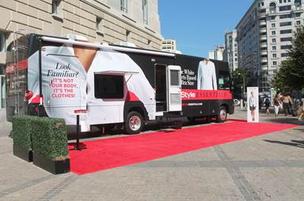
  • InStyle Essentials has a cause-related connection (see photo), with a mobile pop-up in Boston donating one shirt to Dress for Success for every shirt purchased. It's in a busy location and getting a bit of publicity, too.
  • Ten Thousand Villages, the Fair Trade merchant, tried for years to open a holiday season pop-up around Greenville, N.C. This year it happened, building both awareness and sales in the all-important year-end gift-buying period.
  • In Oxfordshire, two online-only businesses have eight-week leases to show their products for the holiday season, hoping to build website business and of course sell some products in person. If all goes well, one or both may open a retail location in 2014.
  • Dockers is reinventing itself for a younger target market, with an introductory pop-up in New York City and a cross-country mobile pop-up tour.


Thursday, November 8, 2012

Holiday Retailing 2012: The Challenge of Showrooming

What does the trend toward showrooming mean for stores and online retailers this holiday season? Showrooming occurs when shoppers examine products in a nearby store but then buy from an online merchant (using a mobile phone or their tablet or personal computer). So many shoppers have smartphones in hand when they visit stores that retailers should expect showrooming to be a way of life from now on.

Remember last December, when Amazon's promotion of its price check app angered store competitors? The company not only encouraged consumers to compare prices when they were at the mall, it also offered a discount for ordering the item from Amazon instead of buying in the store.

Here's how retailers are gearing up for the showrooming challenge in 2012.
  • Target and Best Buy have already announced they will match the prices of online rivals during certain periods. 
  • Some stores are equipping employees with tablets or other devices to help shoppers compare products, understand features, check inventory, and even place orders for same-day pickup (in the store, of course). 
  • To combat showrooming, a number of retailers are offering exclusive merchandise assortments and improving in-store service.
One final consumer behavior point in favor of store shopping is that once a buyer stands in front of a merchandise display and makes a buying decision, he or she may put a higher value on being able to take the product home right away instead of paying less but having to wait a day or two for an online order to be delivered.

Thursday, July 19, 2012

Back-to-School Marketing in Full Swing

The battle for back-to-school purchases has begun. Major retailers like Walmart and Target have been airing commercials and using digital and mobile ads to highlight their seasonal offerings. Walmart's Classrooms microsite brings together supply lists from thousands of U.S. schools, ready for printing or to consult via cell while parents are in the store. Walmart is also using loss-leader school supplies to attract price-sensitive parents.

Walgreen's is part of the "reverse showrooming" trend, in which retailers use mobile coupons or online coupons to bring shoppers into their stores. Showrooming occurs when consumers inspect products in a store and then buy from an online retailer instead. Using sales promotions to encourage in-store shopping, retailers hope that impulse purchasing will increase the size of each shopper's transaction.

Best Buy has a clever idea: "Buy Boards" on major college campuses invite students to use their smartphones and scan the code of electronics products they want to buy. Buyers can have the merchandise delivered to their dorms or ready at a nearby store for pickup.

Tuesday, June 5, 2012

Retail Show-down over Showrooming

Remember last December, when Amazon encouraged in-store shoppers to use its app for price-checking and offered a 5% discount for buying online instead of in the store? That was when showrooming burst into the headlines--consumers looking at products in stores and then buying from an online retailer instead.

Not surprisingly, bricks-and-mortar stores resent being showrooms for the online stores they compete with. With the economy still struggling, buyers notice the difference between store prices and online prices, and try to buy for less when possible. One study shows Amazon's prices 14% lower than Target's, for example. And that's a big reason why pioneer Amazon, known for low prices, is now the 11th-largest retailer in America.

Best Buy has been particularly hard-hit by showrooming. Because of its extensive inventory, Best Buy is the place to go for all things electronic, apparently even when the shopper plans to buy from Amazon or another web-based store. Now Best Buy is closing some of its big-box stores in the US as well as the UK. It will look into opening smaller specialty stores for specific product lines (think mobile phones). Smaller stores = lower costs and better service.

Watch for more changes as the retail industry seeks to combat showrooming through differentiation and, of course, price competition.