I know Ronald McDonald has been blamed for luring kids to eat unhealthy McDonald's meals. And he's also an icon whose time has probably come and gone. So many brands, mascots, and symbols are being updated these days, it's not surprising that McDonald's is deemphasizing Ronald in its marketing efforts.
But let's not forget that Ronald McDonald has a good side--his name, image, and fundraising power are behind the 300+ Ronald McDonald houses that help ill children and their families stay together throughout terrible medical times and months of treatments.
Ronald is doing good works around the world. Below, he rides through Rio de Janeiro on McHappy Day, an annual event that raises enough money to help treat 30,000 ill Brazilian children.
The Ronald McDonald House Charities are very much alive and they serve hundreds of thousands of children and families every year. So even if Ronald the clown is moving out of the marketing spotlight for McDonald's, Ronald as the symbol of the children's charities should get a bit of respect.
Marketing analysis, opinion, and links by Marian Burk Wood, author of Pearson Education's "The Marketing Plan Handbook."
Sunday, March 20, 2011
Wednesday, March 16, 2011
Infrastructure Is the New Frontier
The terrible situation in Japan has caused untold human suffering and loss of lives. As the government and industry leaders assess the damage, help survivors, and prepare to rebuild, it's clear that infrastructure repairs and improvements will be needed just to get started. In other words, infrastructure is the new frontier for Japan.
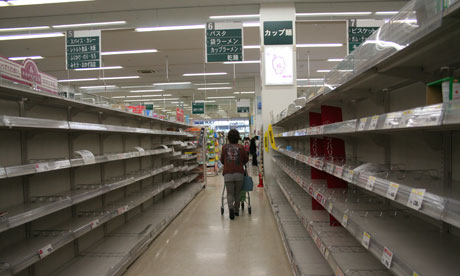
This nearly-empty supermarket is fast becoming the norm throughout Tokyo and surrounding areas. Most streets are dotted with tiny convenience stores that, in ordinary circumstances, would receive daily shipments of fresh foods and ready-to-eat entrees. Vending machines are outside every major train station and on many street corners, and these are usually replenished every couple of days. Now, with train service spotty, and gasoline supplies dwindling or gone, the supply chain can barely function. The result: empty shelves, empty vending machines. And for survivors in the Sendai area, where the tsunami hit, food is scarce despite relief efforts, in part because it's simply a challenge to transport anything into this region.
Electricity is being shut off in different areas of Tokyo for hours at a time, with no end in sight, to conserve power. Imagine the impact on refrigerated foods and medicines that must be kept chilled. Friends in Tokyo say that many businesspeople are staying in downtown hotels because they must be at work but they can't get home to the suburbs. Yet how long can hotels and restaurants stay open when supplies run out and power is turned on and off erratically? Many restaurants are small businesses, and without customers or supplies, their ability to keep going in the long term is obviously in question.
To help its people and rebuild its economy, Japan will have to tackle its infrastructure problems--and quickly. The ripple effect throughout the global marketplace is already being felt. Japanese factories are big suppliers of memory chips for smart phones and other devices. Marketers that depend on Japanese suppliers are being forced to buy from other sources, when they can, and with limited supplies, prices are rising (which means higher retail prices at the end of the channel). Popular electronics products are made in Japan (think Sony Blu-Ray for example) and those factories aren't back to normal quite yet.
Car manufacturers like Toyota that operate local factories are gearing up again following nearly a week at a standstill. But they, too, rely on their supply chain partners for parts and materials. And they need a consistent, reliable power supply to keep their assembly lines going. If gasoline isn't available, Toyota can't get the parts it needs and its cars won't sell in Japan, anyway, if buyers are trying to survive or have money to buy a car but can't get gas.
Infrastructure is Japan's new frontier. It will be very difficult, time-consuming, and costly to rebuild, but Japan has done it before--and it can and will do it again.
This nearly-empty supermarket is fast becoming the norm throughout Tokyo and surrounding areas. Most streets are dotted with tiny convenience stores that, in ordinary circumstances, would receive daily shipments of fresh foods and ready-to-eat entrees. Vending machines are outside every major train station and on many street corners, and these are usually replenished every couple of days. Now, with train service spotty, and gasoline supplies dwindling or gone, the supply chain can barely function. The result: empty shelves, empty vending machines. And for survivors in the Sendai area, where the tsunami hit, food is scarce despite relief efforts, in part because it's simply a challenge to transport anything into this region.
Electricity is being shut off in different areas of Tokyo for hours at a time, with no end in sight, to conserve power. Imagine the impact on refrigerated foods and medicines that must be kept chilled. Friends in Tokyo say that many businesspeople are staying in downtown hotels because they must be at work but they can't get home to the suburbs. Yet how long can hotels and restaurants stay open when supplies run out and power is turned on and off erratically? Many restaurants are small businesses, and without customers or supplies, their ability to keep going in the long term is obviously in question.
To help its people and rebuild its economy, Japan will have to tackle its infrastructure problems--and quickly. The ripple effect throughout the global marketplace is already being felt. Japanese factories are big suppliers of memory chips for smart phones and other devices. Marketers that depend on Japanese suppliers are being forced to buy from other sources, when they can, and with limited supplies, prices are rising (which means higher retail prices at the end of the channel). Popular electronics products are made in Japan (think Sony Blu-Ray for example) and those factories aren't back to normal quite yet.
Car manufacturers like Toyota that operate local factories are gearing up again following nearly a week at a standstill. But they, too, rely on their supply chain partners for parts and materials. And they need a consistent, reliable power supply to keep their assembly lines going. If gasoline isn't available, Toyota can't get the parts it needs and its cars won't sell in Japan, anyway, if buyers are trying to survive or have money to buy a car but can't get gas.
Infrastructure is Japan's new frontier. It will be very difficult, time-consuming, and costly to rebuild, but Japan has done it before--and it can and will do it again.
Sunday, March 13, 2011
Donations to Help Japan
Oh, Japan, what devastation. Want to do something to help in the disaster relief efforts?
- Consider donating to Doctors without Borders (I just did).
- You can donate to the Red Cross via a special iTunes page.
- Donate to Save the Children via Farmville without leaving Facebook (above).
- Texting your donation? You have lots of options.
Tuesday, March 8, 2011
Can Facebook Help Researchers Decode Emotions?
Being able to decode a person's emotional state--just by glancing at his or her face--would be a big boon to marketers. Now researchers think they've cracked the code, training computers to recognize not only facial expressions but also body language and other subtle cues. Here's a quick look at such research:
Can social media further this research? In the words of one researcher, "If you do an experiment on Facebook, you've got half a billion people in your sample."
Wednesday, March 2, 2011
Tablet Computers: Pricing Is Key
Any minute now, Apple will intro its newest iPad, amid much fanfare and anticipation. But Apple isn't the only firm pushing tablet computers.
HTC--the company behind many Android-powered smartphones--is targeting the tablet market with a new product called the Flyer, which features a stylus for input.
With the tablet on the verge of becoming a mature product and new entries proliferating, price is increasingly important to capturing customers new to the category and attracting current users ready to trade up. In fact, a Boston Consulting Group study notes that tablet prices will have to fall further for the product to become truly a mass-market item.
So a price war may actually be on the way, boosting industry volume and putting tablets in the hands of people who otherwise might have purchased a netbook or a new smartphone. Interestingly, an Economist article from last fall found that iPad prices vary from country to country. This suggests pricing latitude and the potential for country-by-country price competition as more tablets come to market.
HTC--the company behind many Android-powered smartphones--is targeting the tablet market with a new product called the Flyer, which features a stylus for input.
With the tablet on the verge of becoming a mature product and new entries proliferating, price is increasingly important to capturing customers new to the category and attracting current users ready to trade up. In fact, a Boston Consulting Group study notes that tablet prices will have to fall further for the product to become truly a mass-market item.
So a price war may actually be on the way, boosting industry volume and putting tablets in the hands of people who otherwise might have purchased a netbook or a new smartphone. Interestingly, an Economist article from last fall found that iPad prices vary from country to country. This suggests pricing latitude and the potential for country-by-country price competition as more tablets come to market.
Thursday, February 24, 2011
Mixing It Up: Social and Mainstream Media
A new Hewlett-Packard study disproves the perception that “the most prolific tweeters or those with most followers would be most responsible for creating” the posts that drive trending topics to the top of Twitter. Instead, the study found that mainstream media such as CNN and BBC are actually amplifying topics, contributing to the trending that drives these topics to the top. For example, when mainstream media reported on the new album by Britney Spears, her name shot up on the Twitter trending chart. The marketing take-away: use a mix of media to engage your audiences.
In fact, the mix of social media being used by consumers in different parts of the world offers ample opportunity for communication, says SearchEngineWatch.com. In Japan, Mobage-Town, a mobile-based social media platform, is increasingly popular (and profitable) because of the ability to connect and play games on the go. Now that Mobage-Town (above) is expanding into other countries, will Facebook react? And for marketers, the lesson is: ignore mobile marketing at your peril.
Facebook and YouTube are gaining in popularity among UK consumers, according to Nielsen/Ukom. Facebook has rocketed to #3 among Web sites accessed in the UK; YouTube is #8 (while Twitter is #38). The same study noted the rapid rise of sites from mainstream media, such as BBC. This reinforces the view that a mix of social and mainstream media is needed to reach and involve audiences.
In fact, the mix of social media being used by consumers in different parts of the world offers ample opportunity for communication, says SearchEngineWatch.com. In Japan, Mobage-Town, a mobile-based social media platform, is increasingly popular (and profitable) because of the ability to connect and play games on the go. Now that Mobage-Town (above) is expanding into other countries, will Facebook react? And for marketers, the lesson is: ignore mobile marketing at your peril.
Facebook and YouTube are gaining in popularity among UK consumers, according to Nielsen/Ukom. Facebook has rocketed to #3 among Web sites accessed in the UK; YouTube is #8 (while Twitter is #38). The same study noted the rapid rise of sites from mainstream media, such as BBC. This reinforces the view that a mix of social and mainstream media is needed to reach and involve audiences.
Wednesday, February 23, 2011
Marketing a Small/Local Business: Thrifty-Plow
Being located in a snow-belt area, I'm a prime customer for driveway plow services. These tend to be owner-operated and hyper-local.
Because this has been one of the snowiest winters on record in my area, plow services have been overloaded with work. To get and keep customers, any plow service must emphasize personalized marketing and reliable service delivery. This is the story of one local business that gets it right.
Earlier this month, I received the newsletter (top) from Bruce, the owner of Thrifty-Plow, who has been clearing my driveway for the past 3 years. Because the current bill (below) was so much higher than usual, Bruce wrote a lengthy explanation of why and how he changed his services to cope with the unprecedented wintery mess.
Now why is this smart marketing? First, Bruce prepared his customers for the big shock of the biggest bills he's ever sent us. He reminded us of the conditions he (and we) faced in clearing driveways, explained in detail how he did a good job despite the major obstacles. He described the scope of his services and what he must do to be sure the job is complete--and closed with a reminder that his rates are as low as he can make them.
The bill, handwritten, detailed every service Bruce provided so customers could figure out what he did and what he charged for each service. Then, because my driveway is among the last to be plowed, Bruce applied a 20% discount "for waiting."
Smart marketing: Even the bill reinforced the value that Bruce provided for the money I pay. Although Bruce had to spend extra time plowing the extraordinary snowfall, he included my discount to show that I received extra value because I'm his customer.
Bruce didn't need colorful materials or flashy logos to get or keep my business. Bruce has no Facebook page, no Twitter feed. I don't care whether his bill is hand-written or computer-generated. In fact, I wrote him a thank-you note along with my check. He keeps the "brand promise" of Thrifty-Plow: He always gets the job done at a reasonable price.
Because this has been one of the snowiest winters on record in my area, plow services have been overloaded with work. To get and keep customers, any plow service must emphasize personalized marketing and reliable service delivery. This is the story of one local business that gets it right.
Earlier this month, I received the newsletter (top) from Bruce, the owner of Thrifty-Plow, who has been clearing my driveway for the past 3 years. Because the current bill (below) was so much higher than usual, Bruce wrote a lengthy explanation of why and how he changed his services to cope with the unprecedented wintery mess.
Now why is this smart marketing? First, Bruce prepared his customers for the big shock of the biggest bills he's ever sent us. He reminded us of the conditions he (and we) faced in clearing driveways, explained in detail how he did a good job despite the major obstacles. He described the scope of his services and what he must do to be sure the job is complete--and closed with a reminder that his rates are as low as he can make them.
The bill, handwritten, detailed every service Bruce provided so customers could figure out what he did and what he charged for each service. Then, because my driveway is among the last to be plowed, Bruce applied a 20% discount "for waiting."
Smart marketing: Even the bill reinforced the value that Bruce provided for the money I pay. Although Bruce had to spend extra time plowing the extraordinary snowfall, he included my discount to show that I received extra value because I'm his customer.
Bruce didn't need colorful materials or flashy logos to get or keep my business. Bruce has no Facebook page, no Twitter feed. I don't care whether his bill is hand-written or computer-generated. In fact, I wrote him a thank-you note along with my check. He keeps the "brand promise" of Thrifty-Plow: He always gets the job done at a reasonable price.
Thursday, February 17, 2011
All Eyes on Watson, IBM's Marketing Triumph
I admit it: I was glued to Jeopardy! on Monday, Tuesday, and Wednesday nights. I even sought out spoilers on Wednesday to learn in advance whether Watson would win (and of course by now, you know he did, by a large margin).
Yes, IBM did seem to turn parts of the program into an infomercial, but the challenge and the story behind Watson are so fascinating that the audience didn't mind one bit.
Watson has brought a ratings bonanza for Jeopardy! during sweeps week and a major marketing triumph for IBM--today and in the months to come. Now when people hear the name "Watson," they'll be as likely to think of the IBM super-computer (named after IBM's founder) as they are to think of the Sherlock Holmes sidekick. Watson has become a celebrity in its own right, inspiring IBMers and members of the viewing public, not to mention kicking off a lively ongoing debate about the capabilities of computers and artificial intelligence.
Smart marketing, IBM: Watson focused the audience's attention on IBM's cutting-edge core competencies in a way that no competitor can duplicate. The amount of media exposure that Watson gained for IBM would have cost tens of millions of dollars, if not more. Watson wins this round!
Yes, IBM did seem to turn parts of the program into an infomercial, but the challenge and the story behind Watson are so fascinating that the audience didn't mind one bit.
Watson has brought a ratings bonanza for Jeopardy! during sweeps week and a major marketing triumph for IBM--today and in the months to come. Now when people hear the name "Watson," they'll be as likely to think of the IBM super-computer (named after IBM's founder) as they are to think of the Sherlock Holmes sidekick. Watson has become a celebrity in its own right, inspiring IBMers and members of the viewing public, not to mention kicking off a lively ongoing debate about the capabilities of computers and artificial intelligence.
Smart marketing, IBM: Watson focused the audience's attention on IBM's cutting-edge core competencies in a way that no competitor can duplicate. The amount of media exposure that Watson gained for IBM would have cost tens of millions of dollars, if not more. Watson wins this round!
Monday, February 14, 2011
Internal Marketing Pays Off: Wegmans
The authors of the annual Fortune "100 Best Places to Work For" list make some wonderful points about why satisfying employees (part of internal marketing) makes good business sense. They note that senior managers at these companies genuinely care about the well-being of their employees, and great workplaces can be found in any industry.
The number one reason is truly the bottom line: It's profitable to treat your employees well. If I had invested in a portfolio of the stocks of the companies on the 1998 list (the first year it was compiled) and then changed my portfolio to reflect the 100 companies on every subsequent list, my annualized return for the 14 years would have been a bit more than 11% per year---far better than the overall market.
Wegmans, the grocery chain based in Western New York, has been at or near the top of Fortune's list for years. This year, it's #3, and it celebrated by offering free cake to customers in every store. "There is nothing more important to us than being a great place to work,” said CEO Danny Wegman. “When our people feel valued and cared about, they make our customers feel the same." [italics are mine]
Customers do indeed feel valued and are incredibly loyal to Wegmans. Alec Baldwin has filmed two commercials for Wegmans, which is one of his mother's favorite places to shop. The company has an active blog and is on YouTube as well as on Twitter (15,000+ followers) and Flickr.
Marketers in any industry would be lucky to have customers who feel as strongly as the loyal customer base at Wegmans. They keep buying from the chain year after year after year (and introducing their friends to the Wegmans experience). Not surprisingly, Wegmans' customers have a heart too: They've increased their donations to hunger relief at the checkout, with the proceeds going to stock local food banks.
The number one reason is truly the bottom line: It's profitable to treat your employees well. If I had invested in a portfolio of the stocks of the companies on the 1998 list (the first year it was compiled) and then changed my portfolio to reflect the 100 companies on every subsequent list, my annualized return for the 14 years would have been a bit more than 11% per year---far better than the overall market.
Wegmans, the grocery chain based in Western New York, has been at or near the top of Fortune's list for years. This year, it's #3, and it celebrated by offering free cake to customers in every store. "There is nothing more important to us than being a great place to work,” said CEO Danny Wegman. “When our people feel valued and cared about, they make our customers feel the same." [italics are mine]
Customers do indeed feel valued and are incredibly loyal to Wegmans. Alec Baldwin has filmed two commercials for Wegmans, which is one of his mother's favorite places to shop. The company has an active blog and is on YouTube as well as on Twitter (15,000+ followers) and Flickr.
Marketers in any industry would be lucky to have customers who feel as strongly as the loyal customer base at Wegmans. They keep buying from the chain year after year after year (and introducing their friends to the Wegmans experience). Not surprisingly, Wegmans' customers have a heart too: They've increased their donations to hunger relief at the checkout, with the proceeds going to stock local food banks.
Wednesday, February 9, 2011
Speedy Marketing for Super Bowl MVP
Aaron Rodgers--the MVP quarterback of Sunday's Super Bowl game in which the Green Bay Packers seriously out-played the Pittsburgh Steelers--is suddenly a hot marketing face.
Before the big game, USA Today quoted Bob Dorfman of Baker Street Advertising as saying that Rodgers would be the "most marketable" if his Packers won. Dorfman was right.
Almost as soon as the game was over, it seems, he was starring in a Disney commercial ("I'm going to Disney World!") and he had a milk mustache already running for the iconic Got Milk campaign.
Assuming that the NFL owners and players work out their differences, the next Super Bowl will be on February 5, 2012. Will Rodgers continue his marketing reign at Indianapolis?
Before the big game, USA Today quoted Bob Dorfman of Baker Street Advertising as saying that Rodgers would be the "most marketable" if his Packers won. Dorfman was right.
Almost as soon as the game was over, it seems, he was starring in a Disney commercial ("I'm going to Disney World!") and he had a milk mustache already running for the iconic Got Milk campaign.
Assuming that the NFL owners and players work out their differences, the next Super Bowl will be on February 5, 2012. Will Rodgers continue his marketing reign at Indianapolis?