Showing posts with label grocery retailing. Show all posts
Showing posts with label grocery retailing. Show all posts
Sunday, July 28, 2019
Store Brands Continue Strong Growth
Value-minded consumers are choosing private-label store brands in many cases, cutting into the sales of established manufacturer brands. Not surprisingly, grocery chains such as Kroger are feeding this trend by increasing the breadth and depth of their private-label product mix.

Tuesday, June 19, 2018
Ocado Technology Crosses the Pond
 |
| Image from Ocado Group's website |
The company has developed a highly efficient warehouse system that uses robots to pick and pack. See it in operation here.
Now the US supermarket chain Kroger has an exclusive deal with Ocado to build a series of robotic grocery warehouses across America. Ocado's technology will also help Kroger with delivery logistics, a key element.
Currently, Walmart dominates the US grocery business . . . and Amazon's acquisition of Whole Foods Markets turned up the competitive heat last year.
In the long run, Kroger wants to drive down costs and increase efficiency and customer service by transitioning to Ocado's system. Ocado's CEO says the deal with Kroger will "reshape the food retailing industry in the U.S. in the years to come." Meanwhile, how will consumer behavior shape the industry and competition among grocery retailers, online and in stores?
Monday, June 11, 2018
Hummus Market Is Humming


One of the featured brands is Ithaca, named for a city in upstate New York, where Wegmans got its start. Smart marketing move to give Ithaca chainwide distribution on the East Coast rather than confining it to New York. Variety-seeking consumers and dedicated hummus-lovers outside of NY will see this unfamiliar brand, check out its unique attributes, and give it a try.
In the overall U.S. market, Sabra is the dominant brand, a market-leading position it's held for years. It's growing rapidly and expanding its R&D and manufacturing to keep up with high demand.
Wegmans carries Sabra, of course. But the diverse brands in each of its stores help to differentiate Wegmans from national supermarket chains, encouraging shoppers to return for unique and interesting choices. For the hummus brands, the marketing objective in this competitive marketplace is to secure distribution, raise brand awareness, and reinforce brand loyalty.
Note: This is post #1200 for my Marketing Handbook Blog.
Sunday, May 20, 2018
The Sneakerization of the Non-Dairy Milk Market

The increase in number and variety of non-dairy milk products illustrates the "sneakerization" of this market--meaning the proliferation of multiple products for microtargeting niche or microniche consumer segments. Ever-finer market segmentation for targeting small niches interested in specific types of products/benefits, in other words.
Even calling these products "___milk" can be controversial. But despite industry efforts like the long-running "Got Milk?" campaign (which morphed into "Milk Life"), consumption of traditional dairy milk is not going up.
In fact, many consumers are seeking out milk alternatives for health, nutrition, and lifestyle reasons.
Consumers are paying attention to these non-dairy milks and seeking out new choices, boosting demand for what was once a tiny niche. This is changing the makeup of the industry. For instance, adapting to this trend toward proliferation of non-milk products, one former dairy producer now makes peanut milk.
Sneakerization of this market means more competition among non-dairy milk products AND milk products, all seeking to improve market share, sales, and profitability.
Thursday, March 24, 2016
Panera at Home Meets Consumers in Grocery Stores

Panera has high brand recognition and positive associations with tasty, wholesome foods. Known in particular for fresh-baked breads and imaginative soups, Panera has adapted and packaged some of those products for retail grocery distribution, marketed through its Panera at Home division. Above, one of the packaged breads that Panera is selling through major grocery chains such as Stop & Shop.
The idea is to leverage "brand credibility" and expand beyond the restaurants into packaged goods, catering, and delivery. In today's highly competitive fast-casual restaurant industry, additional product/distribution plans are a plus for reaching more consumers and increasing revenues for the long term.
Panera also has been polishing its reputation for healthy foods by removing artificial colors and other "no nos" from its soups, including the packaged soups sold in grocery stores. This process will be complete by the end of 2016.
The firm developed a special video to explain Panera 2.0 (digital initiatives and more) to its employees and other stakeholders. You can view it here.
Sunday, March 8, 2015
Pirate Joe, Gray Marketeer
PIRATE JOE'S - NOT AUTHORIZED BY
TRADER JOE'S
This weekend's Wall Street Journal has a front-page story about a gray market matter: Pirate Joe's, an unabashedly unauthorized grocery retailer that buys legitimate Trader Joe's merchandise in California and sells the products in Vancouver.
What makes Pirate Joe unique is that it pays Trader Joe's retail prices and brings the merchandise to Canada where it sells products at a markup to local buyers. Pirate Joe tells customers up front that it's not affiliated with Trader Joe, and not authorized as a reseller.
Gray market retailers usually obtain products illegally but here, Pirate Joe sends "secret shoppers" to Trader Joe to scoop up products at regular retail prices. They drive to Canada and unload the merchandise for Pirate Joe to resell.
Trader Joe is not amused. It's sued Pirate Joe, but so far, the courts haven't stopped Pirate Joe from retailing Trader Joe products purchased legally in America.
Pirate Joe's Canadian customers sometimes grumble about the high prices but if they don't feel like driving a couple of hours across the border to a Trader Joe store, at least they can buy more conveniently in Vancouver.
Thursday, December 26, 2013
Strolling Down the Starbucks Signature Aisle
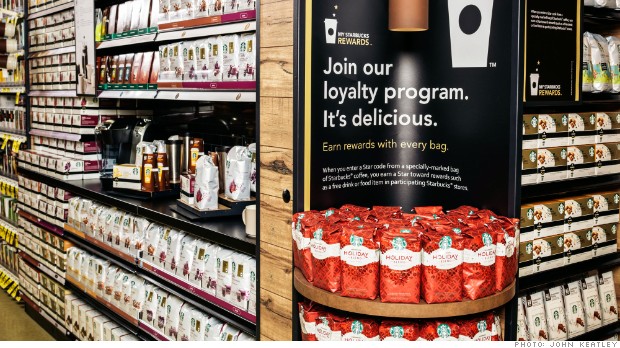
Now that Starbucks stores are everywhere, the company that brought coffee culture to America is seeking growth through branded packaged products sold in other stores.
The biggest battleground is in supermarkets. Above, a Starbucks Signature Aisle located inside a Safeway supermarket, showing the special holiday blend and the loyalty program Starbucks is offering to reward frequent buyers, an extension of its highly successful cafe rewards program. Don't forget Evolution Fresh juices (acquired in 2011) and the new yogurt to be cobranded with Danone.
To prepare for this latest growth strategy, Starbucks ended its long-time deal with Kraft, which was its original partner for packaged-coffee sold in supermarkets. Even though the divorce cost Starbucks more than $2.7 billion, the company viewed it as a necessary step toward further expansion.
Knowing what customers buy in a cafe and in a store will help Starbucks do a better job of targeting and promoting all of its foods and beverages.
Meanwhile, watch for more Starbucks cafes with localized decor as 2014 arrives. And if you're the one of the one in 10 Americans who (according to company estimates) receives a Starbucks gift card this holiday season, enjoy!
Wednesday, December 5, 2012
Tesco's Tough Time with Fresh & Easy

Tesco's researchers observed US shoppers at close quarters and studied market dynamics for two years before the first Fresh & Easy stores opened in Arizona, California, and Nevada in 2007.
Based on what they learned, Tesco's original strategy was to exploit a gap in the market between small-format convenience stores and large-scale supermarkets and superstores.
Fresh & Easy was to be a neighborhood market featuring easy-in, easy-out shopping for fresh fruits, vegetables, and prepared foods, with everyday low pricing (EDLP). In other words, the merchandise would be fresh and the shopping would be easy (and easy on the wallet).
The long-term plan was to have 1,000 stores stretching the coast from California to Washington state. Never mind that those states already have plenty of supermarkets and superstores selling produce and related foods, including powerhouses like Trader Joe's, Costco, Walmart, and Whole Foods. Tesco believed its fresh concept and core competency in food retailing would bring something new and different to the US market. Tesco even invested in a gigantic distribution center to serve the huge network of stores in the works.
However, Tesco soon found that competition was much fiercer than expected. Even worse, the global financial crisis pushed the economy into a tailspin and the Western states where its first Fresh & Easy stores were located suffered particularly severe and prolonged downturns. Shoppers became accustomed to bargain-hunting for promotional pricing, not Fresh & Easy's EDLP pricing strategy.
Meanwhile, Fresh & Easy lacked the high profile and positive brand associations it needed to attract and retain shoppers. Even though a belated advertising campaign, new color scheme, new merchandise categories for US shoppers' preferences, and promotional pricing helped slow the losses, these moves couldn't boost sales and customer counts to break-even levels quickly enough.
After years of multimillion dollar losses and no break-even date in sight for Fresh & Easy, Tesco today announced it was conducting a strategic review of the US grocery chain. Whether Fresh & Easy is sold or shuttered, the experience has been painful and profit-sapping for Tesco.