Showing posts with label supermarkets. Show all posts

Tuesday, June 19, 2018

Ocado Technology Crosses the Pond

Image from Ocado Group's website
Ocado is well-known in the UK for its efficient web -based grocery retailing business. Today, more than half a million consumers shop online at Ocado's e-commerce site and have their groceries delivered.

The company has developed a highly efficient warehouse system that uses robots to pick and pack. See it in operation here.

Now the US supermarket chain Kroger has an exclusive deal with Ocado to build a series of robotic grocery warehouses across America. Ocado's technology will also help Kroger with delivery logistics, a key element.

Currently, Walmart dominates the US grocery business . . . and Amazon's acquisition of Whole Foods Markets turned up the competitive heat last year.

In the long run, Kroger wants to drive down costs and increase efficiency and customer service by transitioning to Ocado's system. Ocado's CEO says the deal with Kroger will "reshape the food retailing industry in the U.S. in the years to come." Meanwhile, how will consumer behavior shape the industry and competition among grocery retailers, online and in stores?

Wednesday, May 23, 2018

Yogurt, yogurt everywhere

Walk into any supermarket or health-foods store today, and you'll see a vast array of yogurts in the dairy case. Flash back just 11 years, and the yogurt offerings were meager, to say the least. Dannon was marketing yogurt in US stores, but the food category was miniscule and anything but mainstream.

The incredible growth of yogurt during the 21st century is due, in large part, to the entrance of one brand--Chobani, which launched its Greek yogurt in 2007.

Today, Chobani is competing with brands that didn't exist in 2007, as well as brand and product extensions of companies that were part of the yogurt market in the 20th century. Consumers have responded to the new wave of yogurts by trying new products and, in some cases, becoming loyal yogurt lovers.

No wonder Chobani has been redesigning its products and packaging to stand out in this increasingly crowded environment. The company is also reformulating yogurts with lower sugar and more flavor pop. And it's "stretching" the branded yogurt concept into drinkable products, among other innovations.

Yogurt is everywhere. How will Chobani, Dannon, and other brands maintain the interest and loyalty of consumers in such a competitive marketplace?

Sunday, May 20, 2018

The Sneakerization of the Non-Dairy Milk Market

Does the "dairy case" in your local supermarket include rows of shelves with alternatives like soy milk and almond milk?

The increase in number and variety of non-dairy milk products illustrates the "sneakerization" of this market--meaning the proliferation of multiple products for microtargeting niche or microniche consumer segments. Ever-finer market segmentation for targeting small niches interested in specific types of products/benefits, in other words.

Even calling these products "___milk" can be controversial. But despite industry efforts like the long-running "Got Milk?" campaign (which morphed into "Milk Life"), consumption of traditional dairy milk is not going up.

In fact, many consumers are seeking out milk alternatives for health, nutrition, and lifestyle reasons.

Consumers are paying attention to these non-dairy milks and seeking out new choices, boosting demand for what was once a tiny niche. This is changing the makeup of the industry. For instance, adapting to this trend toward proliferation of non-milk products, one former dairy producer now makes peanut milk.

Sneakerization of this market means more competition among non-dairy milk products AND milk products, all seeking to improve market share, sales, and profitability.

Thursday, October 19, 2017

Shopper Marketing Coordinated with Social Media Marketing

With Halloween approaching, store displays and social media accounts are promoting the season with limited-edition pumpkin-spiced products and Halloween treats galore.

Above, packages of a limited-edition Hostess baked treat displayed on a supermarket endcap. These Glo Balls are a seasonal variation on the brand's Sno Balls products. Interstate Bakeries acquired the Hostess brands in 1995 and changed its corporate name to Hostess in 2009. More than 1.2 million brand fans have clicked to like the Hostess Facebook page.

Another familiar technique for shopper marketing is to use a seasonal point-of-purchase display. This Hershey Halloween cardboard display, at the front of a supermarket, has plenty of room for family-sized bags of Hershey-branded candies, for home or for trick-or-treat give-aways. The company also promotes recipes and crafts featuring its branded chocolates on the web and social media. Nearly 10 million people have liked Hershey's Facebook page, by the way.

Finally, an unusual pumpkin-spiced product: Gouda cheese, found in the supermarket's cheese refrigerated case. Only for a limited time. Not the usual autumn flavor combo, to say the least.


Monday, September 4, 2017

Once Again, It's Pumpkin Everything in the Food World

Pumpkin everything season now begins in late summer. Starbucks showed imagination in launching its Pumpkin Spice Latte via live-streaming, building on anticipation from fans. Dunkin' Donuts is doubling down on pumpkin coffees and muffins: "We’ve seen our fans ask for pumpkin earlier and earlier each year," the company explains.

In general, pumpkin everything is turning everything orange in the food aisles and in cafes well before autumn arrives. Some marketers, like Krispy Kreme, really limit the limited-time pumpkin trend: It will offer a pumpkin-spice doughnut for one day only.

Other marketers are riding the pumpkin wave for weeks or months. How about a Kit Kat Pumpkin Pie bar? Or pumpkin spice breakfast cereals like Cheerios? Pumpkin everything reigns in food marketing for autumn.

Thursday, December 26, 2013

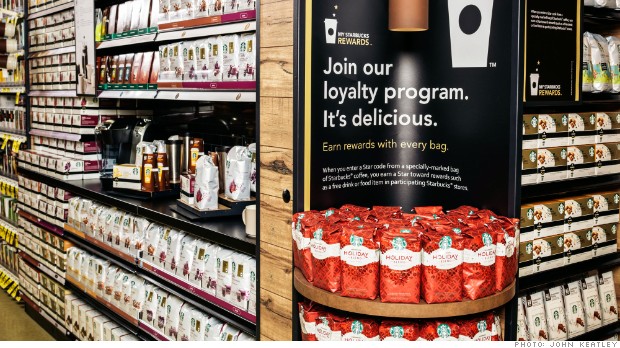
Strolling Down the Starbucks Signature Aisle


Now that Starbucks stores are everywhere, the company that brought coffee culture to America is seeking growth through branded packaged products sold in other stores.

The biggest battleground is in supermarkets. Above, a Starbucks Signature Aisle located inside a Safeway supermarket, showing the special holiday blend and the loyalty program Starbucks is offering to reward frequent buyers, an extension of its highly successful cafe rewards program. Don't forget Evolution Fresh juices (acquired in 2011) and the new yogurt to be cobranded with Danone.

To prepare for this latest growth strategy, Starbucks ended its long-time deal with Kraft, which was its original partner for packaged-coffee sold in supermarkets. Even though the divorce cost Starbucks more than $2.7 billion, the company viewed it as a necessary step toward further expansion.

Knowing what customers buy in a cafe and in a store will help Starbucks do a better job of targeting and promoting all of its foods and beverages.

Meanwhile, watch for more Starbucks cafes with localized decor as 2014 arrives. And if you're the one of the one in 10 Americans who (according to company estimates) receives a Starbucks gift card this holiday season, enjoy!

Sunday, September 2, 2012

Supermarkets Rev Up Wedding-Cake Revenues

As independent bakeries disappear from many suburban areas, supermarkets with in-house bakeries are courting couples who want anything from a basic wedding cake to an elaborately decorated extravaganza.

Often, customers can save hundreds of dollars by buying from a supermarket, thanks to a large company's buying power and efficiency. Another reason, apart from price: Wedding-related reality shows and cooking shows are putting the spotlight on custom creations, giving couples ideas they can adapt for their special day (and their budget). Supermarkets are sending their bakers to school to learn these trendy techniques and come back prepared for almost any special event challenge.
Cake by Publix

Publix Supermarkets, headquartered in Florida, has offered wedding cakes for many years. Last year alone, it reported a 4% increase in wedding-cake sales. The retailer advertises in wedding magazines and exhibits at wedding expos around its five-state trading area. Some branches include an in-house event planning service, Apron's, to help customers with customized cakes, food, flowers and other special-event needs.

Cake by Farm Fresh
Farm Fresh and other supermarkets owned by Supervalu, based in Minnesota, are also boosting their bakery business with a 5% increase in wedding cake sales, year over year. "We’re working in various ways to promote our wedding cakes — word of mouth, in-store information and bridal shows," a Supervalu exec tells Supermarket News.

Of course, couples that order a cake from the local supermarket may also look at flowers while they're in the store...