Walk into any supermarket or health-foods store today, and you'll see a vast array of yogurts in the dairy case. Flash back just 11 years, and the yogurt offerings were meager, to say the least. Dannon was marketing yogurt in US stores, but the food category was miniscule and anything but mainstream.
The incredible growth of yogurt during the 21st century is due, in large part, to the entrance of one brand--Chobani, which launched its Greek yogurt in 2007.
Today, Chobani is competing with brands that didn't exist in 2007, as well as brand and product extensions of companies that were part of the yogurt market in the 20th century. Consumers have responded to the new wave of yogurts by trying new products and, in some cases, becoming loyal yogurt lovers.
No wonder Chobani has been redesigning its products and packaging to stand out in this increasingly crowded environment. The company is also reformulating yogurts with lower sugar and more flavor pop. And it's "stretching" the branded yogurt concept into drinkable products, among other innovations.
Yogurt is everywhere. How will Chobani, Dannon, and other brands maintain the interest and loyalty of consumers in such a competitive marketplace?
Marketing analysis, opinion, and links by Marian Burk Wood, author of Pearson Education's "The Marketing Plan Handbook."
Showing posts with label brand loyalty. Show all posts
Wednesday, May 23, 2018
Tuesday, June 13, 2017
Ecosystem Brands Rule
The well-known BrandZ ranking of top global brands (by value) is out--and so-called ecosystem brands are leading the way, yet again.
In 2017, the top 10 brands, as ranked by BrandZ in terms of value, are:
10. McDonald's (US-based)
9. IBM (US)
8. Tencent, owner of WeChat (Chinese)
7. Visa (US)
6. AT&T (US)
5. Facebook (US)
4. Amazon (US) - ecosystem brand
3. Microsoft (US) - ecosystem brand
2. Apple (US) - ecosystem brand
1. Google (US) - ecosystem brand
A senior BrandZ exec says: "Ecosystem brands cleverly meet our needs and make our lives easier by offering us all sorts of things that are connected so we gain this traction with them."
In other words, Microsoft and other ecosystem brands encourage repeat purchasing and brand loyalty with multiple offerings that supplement and coordinate with each other. Microsoft and Apple, for instance, offer operating systems . . . software . . . hardware . . . services . . . and so on. The more offerings a customer buys into over time, the higher the lifetime customer value. Ecosystem brands offer value and, in turn, customers value those brands highly.
In 2017, the top 10 brands, as ranked by BrandZ in terms of value, are:
10. McDonald's (US-based)
9. IBM (US)
8. Tencent, owner of WeChat (Chinese)
7. Visa (US)
6. AT&T (US)
5. Facebook (US)
4. Amazon (US) - ecosystem brand
3. Microsoft (US) - ecosystem brand
2. Apple (US) - ecosystem brand
1. Google (US) - ecosystem brand
A senior BrandZ exec says: "Ecosystem brands cleverly meet our needs and make our lives easier by offering us all sorts of things that are connected so we gain this traction with them."
In other words, Microsoft and other ecosystem brands encourage repeat purchasing and brand loyalty with multiple offerings that supplement and coordinate with each other. Microsoft and Apple, for instance, offer operating systems . . . software . . . hardware . . . services . . . and so on. The more offerings a customer buys into over time, the higher the lifetime customer value. Ecosystem brands offer value and, in turn, customers value those brands highly.
Thursday, December 26, 2013
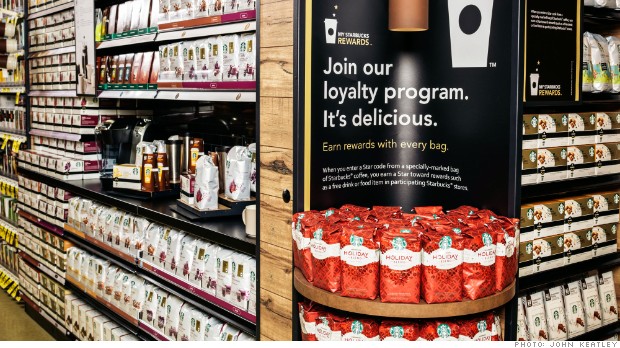
Strolling Down the Starbucks Signature Aisle
Now that Starbucks stores are everywhere, the company that brought coffee culture to America is seeking growth through branded packaged products sold in other stores.
The biggest battleground is in supermarkets. Above, a Starbucks Signature Aisle located inside a Safeway supermarket, showing the special holiday blend and the loyalty program Starbucks is offering to reward frequent buyers, an extension of its highly successful cafe rewards program. Don't forget Evolution Fresh juices (acquired in 2011) and the new yogurt to be cobranded with Danone.
To prepare for this latest growth strategy, Starbucks ended its long-time deal with Kraft, which was its original partner for packaged-coffee sold in supermarkets. Even though the divorce cost Starbucks more than $2.7 billion, the company viewed it as a necessary step toward further expansion.
Knowing what customers buy in a cafe and in a store will help Starbucks do a better job of targeting and promoting all of its foods and beverages.
Meanwhile, watch for more Starbucks cafes with localized decor as 2014 arrives. And if you're the one of the one in 10 Americans who (according to company estimates) receives a Starbucks gift card this holiday season, enjoy!
Sunday, September 15, 2013
Marketing Mallomars, the Century-Old Cookies
Have you heard of Mallomars? The cookies are produced only during cool weather, starting with a graham cracker base, topped with a marshmallow filling, and coated with chocolate.
Because of limited availability, Mallomars has developed a bit of a mystique among brand fans. A search for Mallomars turns up more than 58,000 hits, many of them blog entries or inquiries by people who love the cookies and look forward to their reappearance every September.
Now that the brand is marking its 100th birthday, parent company Nabisco (part of Mondelez, the company formerly known as Kraft) has created a special Facebook page for the cookies. Stores in the Northeast are trumpeting the arrival of Mallomars with signage and special point-of-sale displays that boost the profile of this usually low-key cookie.
Although the Mallomars brand is less well known than Oreo--which celebrated its centennial in 2012, also orchestrated by parent Nabisco--loyal brand fans are buzzing about the cookie's birthday and, just as important, they're buying boxes for themselves and for their friends.
Because of limited availability, Mallomars has developed a bit of a mystique among brand fans. A search for Mallomars turns up more than 58,000 hits, many of them blog entries or inquiries by people who love the cookies and look forward to their reappearance every September.
Now that the brand is marking its 100th birthday, parent company Nabisco (part of Mondelez, the company formerly known as Kraft) has created a special Facebook page for the cookies. Stores in the Northeast are trumpeting the arrival of Mallomars with signage and special point-of-sale displays that boost the profile of this usually low-key cookie.Although the Mallomars brand is less well known than Oreo--which celebrated its centennial in 2012, also orchestrated by parent Nabisco--loyal brand fans are buzzing about the cookie's birthday and, just as important, they're buying boxes for themselves and for their friends.
Wednesday, November 21, 2012
Marketing to Millennials: Value, Shared Experiences, Sustainability
One-third of the world's population can be classified as the Millennial generation (roughly, those born after 1980), according to recent research by Viacom. Not surprisingly, the economy stands out as an important factor affecting their use of credit cards and buying decisions in general. This segment has a unique attitude and perspective on the world, shaped by the economic turmoil of recent years plus their upbringing, their cultural backgrounds, and their life experiences.
As a result, marketers are targeting the Millennial generation with distinctive, value-rich products for their preferences, using quirky, nonconformist communications that avoid the hard sell (unless tinged with irony, of course). Even the shopping experience itself is different for this generation, often mobile or digital, often shared, and heavy on the search for local and/or unique "personality" products to express personal values.
Take the Chevy Spark, for instance, a sub-compact car that comes in eye-catching colors/designs (see above) and is also available with an electric motor. The car is affordable, the design grabs the eye, the size is just right for city driving and parking, and the gas efficiency makes sense for a Millennial buyer making a first or second new car purchase. This is not your grandpa's car--it's clearly a "now" model designed for tastes and preferences of the target market.
Then there's the market for travel services, such as airline tickets, lodgings, and tourism. Research presented at a travel industry meeting shows that Millennials like to travel with friends and expect value for the money (not necessary budget, but value for the money). Unlike traditional "group tours," the goal is to have a shared experience, and sustainability is a major factor in many travel decisions made by this cohort.
Although some experts suggest that Millennials are anything but brand-loyal, remember that they're very open to trying new brands and products (no-brands included!) and like to share the results with friends. Any brand or product that makes the grade has a good chance of being in the consideration set next time around.
As a result, marketers are targeting the Millennial generation with distinctive, value-rich products for their preferences, using quirky, nonconformist communications that avoid the hard sell (unless tinged with irony, of course). Even the shopping experience itself is different for this generation, often mobile or digital, often shared, and heavy on the search for local and/or unique "personality" products to express personal values.
Take the Chevy Spark, for instance, a sub-compact car that comes in eye-catching colors/designs (see above) and is also available with an electric motor. The car is affordable, the design grabs the eye, the size is just right for city driving and parking, and the gas efficiency makes sense for a Millennial buyer making a first or second new car purchase. This is not your grandpa's car--it's clearly a "now" model designed for tastes and preferences of the target market.
Then there's the market for travel services, such as airline tickets, lodgings, and tourism. Research presented at a travel industry meeting shows that Millennials like to travel with friends and expect value for the money (not necessary budget, but value for the money). Unlike traditional "group tours," the goal is to have a shared experience, and sustainability is a major factor in many travel decisions made by this cohort.
Although some experts suggest that Millennials are anything but brand-loyal, remember that they're very open to trying new brands and products (no-brands included!) and like to share the results with friends. Any brand or product that makes the grade has a good chance of being in the consideration set next time around.
Monday, August 15, 2011
How to Make BFFs (Brand Fans Forever)
What marketer wouldn't want loyalty, in the form of Brand Fans Forever?
To make BFFs, your brand must be:
| Ford "Warriors in Pink" promo |
To make BFFs, your brand must be:
- Liked. Not cute, not cuddly, but likable. Apple is liked. It has a "good guy" image. Southwest Airlines is liked. Walmart wants to be liked and is working hard on this element...part of brand management 101.
- Respected. Nobody wants to be BFF with a sleazy outfit. Your brand must act responsibly, treat stakeholders with courtesy, and deliver on its promises. Ford is respected because it's steadily going green, living within its financial means, and working hard to deliver vehicles that drivers want and need.
- Trustworthy. Brands that do the right thing will earn the trust of their customers, suppliers, and distributors. If you can't trust a brand, you might buy it occasionally, but you won't be its BFF. Facebook is at a key juncture now, with some loyal users angry at its privacy missteps. If users come to believe that FB can't be trusted with their personal data and messages, Google+ may be the big social media winner.
- Relevant. Even the most loyal BFF may need a change to remain relevant and valued as needs/markets/technologies change. Your brand should be flexible enough to change with the times yet deliver value without losing its likability, respectability, or trustworthiness. Maybe you need a new package or flavor or line extension, whatever value update will keep your brand relevant to its existing BFFs and attract new BFFs. Frito-Lay does this by adding new flavors, making snacks healthier, and changing packaging to look current.
Monday, July 25, 2011
Brands Are Built on Trust
McDonald's new UK vp of food and marketing made an interesting point during a recent interview with Marketing Week. Here's his quote:
If a brand doesn't keep its promise, the loss of trust can be crippling or even fatal. When a scandal erupts, such as the recent revelation that high-end Da Vinci furniture sold in China as "made in Italy" was really made in China and had quality problems to boot, it's no wonder that consumers lose confidence in the brand. Brands can regain trust, but it takes time and a lot of effort to do so.
Remember, consumers are willing to pay a price premium for brands they trust. In other words, trust is a bottom-line issue. All you have to do is look at Fortune's list of the World's Most Admired Companies to see that the most admired firms--which market brands trusted by loyal customers--are generally highly profitable. McDonald's is #10 on that list. Apple is #1. Enough said!
Our evidence from talking to customers is that trust in our brand is higher than ever - last year we reached a point where more people trusted us than didn’t, which is important.Brands are built on trust. The higher the trust, the stronger the brand--which increases the possibility that customers will be attracted to the brand and remain loyal over the long term. McDonald's keeps its brand promise with every transaction in every outlet around the world.
If a brand doesn't keep its promise, the loss of trust can be crippling or even fatal. When a scandal erupts, such as the recent revelation that high-end Da Vinci furniture sold in China as "made in Italy" was really made in China and had quality problems to boot, it's no wonder that consumers lose confidence in the brand. Brands can regain trust, but it takes time and a lot of effort to do so.
Remember, consumers are willing to pay a price premium for brands they trust. In other words, trust is a bottom-line issue. All you have to do is look at Fortune's list of the World's Most Admired Companies to see that the most admired firms--which market brands trusted by loyal customers--are generally highly profitable. McDonald's is #10 on that list. Apple is #1. Enough said!
Wednesday, June 1, 2011
Milton Friedman Was Right (For the Wrong Reasons)
A new study by academic experts at Tuck shows that social responsibility can strengthen customer loyalty--if the program affects the customer experience. Intuitively, this makes sense: Customers, employees, stockholders, and suppliers prefer to associate with companies and brands that do good things (save the planet, raise money for good causes, buy local products). Other studies and surveys have also found that customers like buying from companies that make a difference.
A number of studies and meta-analyses have confirmed the positive link between social responsibility and profitability. This doesn't mean that corporate social responsibility is the cause of higher profitability, but there is a definite connection.
Of course, social responsibility entails an economic calculation as well as a marketing calculation. And that's where the views of economist Milton Friedman come in.
Decades ago, Friedman famously called on businesses to focus on their "social responsibility" to serve shareholders by increasing profitability. In other words, profits come first.
These days, analysts and industry observers have noted that many social responsibility programs benefit the company economically, by cutting costs, for example, or by polishing the firm's image for marketing reasons (in the interest of sales and profits).
When heavyweights like Walmart, Procter & Gamble, and McDonald's throw their considerable marketing and economic power behind an issue, they can make a real difference, which gives their brands a boost and helps their competitive position. And companies that seek to protect their supply chains or develop unique products wind up helping their sales and profits while they help the environment, as this recent Time article points out.
So it turns out that Milton Friedman was actually correct: His view of businesses being responsible primarily to shareholders/owners underscores the economic importance of corporate social responsibility in the 21st century.
Businesses that don't act in a socially-responsible manner will be at a disadvantage in maintaining customer loyalty, building profits, and satisfying their shareholders. Social responsibility turns out to be a win-win for businesses and society, in a bottom-line way that Friedman may never have thought possible.
A number of studies and meta-analyses have confirmed the positive link between social responsibility and profitability. This doesn't mean that corporate social responsibility is the cause of higher profitability, but there is a definite connection.
Of course, social responsibility entails an economic calculation as well as a marketing calculation. And that's where the views of economist Milton Friedman come in.
Decades ago, Friedman famously called on businesses to focus on their "social responsibility" to serve shareholders by increasing profitability. In other words, profits come first.
These days, analysts and industry observers have noted that many social responsibility programs benefit the company economically, by cutting costs, for example, or by polishing the firm's image for marketing reasons (in the interest of sales and profits).
When heavyweights like Walmart, Procter & Gamble, and McDonald's throw their considerable marketing and economic power behind an issue, they can make a real difference, which gives their brands a boost and helps their competitive position. And companies that seek to protect their supply chains or develop unique products wind up helping their sales and profits while they help the environment, as this recent Time article points out.
So it turns out that Milton Friedman was actually correct: His view of businesses being responsible primarily to shareholders/owners underscores the economic importance of corporate social responsibility in the 21st century.
Businesses that don't act in a socially-responsible manner will be at a disadvantage in maintaining customer loyalty, building profits, and satisfying their shareholders. Social responsibility turns out to be a win-win for businesses and society, in a bottom-line way that Friedman may never have thought possible.
Saturday, July 10, 2010
Smart Subaru Loyalty Marketing
Each customer enters his or her name and address, an e-mail address or phone number, and the VIN of the Subaru owned. Customers specify how many Subarus they've owned (in my case, 4) and can request lifestyle icons to be included on the badge (such as the snow sports icon shown above).
This is such a simple but effective brand loyalty-reinforcement gimmick that I had to blog about it--right after I clicked to order mine.
Here's what makes this clever:
- Subaru owners self-select to show their loyalty to the brand.
- Subaru now knows how many of its vehicles I've owned (since I entered that number when requesting the badge).
- Subaru now knows a bit about my lifestyle interests (snow sports, for example).
- Subaru now has my e-mail or phone for contact purposes, plus my address.
- Subaru asks owners to suggest other lifestyle icons to be offered (gaining insight into other customer interests)
- Subaru can connect owners to specific vehicles and demographic info, updating its database.
- Subaru's car-lover forums and dealers have something unique to talk about.
- Subaru's customers feel they're part of the "in crowd" when they spot these badges on other cars.
Tuesday, September 22, 2009
Who really owns your brand?
Attention, marketers: You think you own your brand? Actually, you should hope that your customers own it. My experience last night is a perfect example of who really owns a brand.
With five friends sitting around a neighbor's dining room table, one got the group's attention by telling how Moen lived up to its warranty by sending a replacement for her leaky kitchen faucet--via FedEx. Good thing she'd saved the receipt from the purchase 9 years before! Moen was her brand and she was proud to talk about her wonderful customer experience and urge all of us to buy Moen.
Another friend said she'd used Bank of America's bill payment service to pay her credit card bill. A few days later, when she tried to use the card, the charge wasn't approved and she didn't know why. Rushing home, she logged into her account and discovered that she'd authorized payment to the wrong card. She called B of A and the rep immediately applied the payment to the proper card and waived all fees. B of A was her brand, and she couldn't be happier with the way things turned out.
Clearly, these positive experiences had reinforced each friend's choice of brand--and just as clearly, we listeners were impressed at how well the companies had lived up to their brands' promises. No marketer can buy such enthusiastic and spontaneous word of mouth or think up testimonials as credible and compelling as these real-life experiences.
In brief, marketers: Give your customers the kinds of experiences that will make them want to own the brand.
With five friends sitting around a neighbor's dining room table, one got the group's attention by telling how Moen lived up to its warranty by sending a replacement for her leaky kitchen faucet--via FedEx. Good thing she'd saved the receipt from the purchase 9 years before! Moen was her brand and she was proud to talk about her wonderful customer experience and urge all of us to buy Moen.
Another friend said she'd used Bank of America's bill payment service to pay her credit card bill. A few days later, when she tried to use the card, the charge wasn't approved and she didn't know why. Rushing home, she logged into her account and discovered that she'd authorized payment to the wrong card. She called B of A and the rep immediately applied the payment to the proper card and waived all fees. B of A was her brand, and she couldn't be happier with the way things turned out.
Clearly, these positive experiences had reinforced each friend's choice of brand--and just as clearly, we listeners were impressed at how well the companies had lived up to their brands' promises. No marketer can buy such enthusiastic and spontaneous word of mouth or think up testimonials as credible and compelling as these real-life experiences.
In brief, marketers: Give your customers the kinds of experiences that will make them want to own the brand.
Friday, September 5, 2008
Lessons from Lux Radio Theatre
|
The Lux Radio Theatre brought Hollywood shine to Lever Brothers’ Lux soap. Originally broadcast from New York City, the weekly radio program took on new life after Danny Danker, a JWT executive, suggested moving it to Hollywood and hiring well-known stars to perform high-quality shows based on hit movies of the day. Hosted by the legendary Cecil B. DeMille, the program was a big-budget extravaganza complete with full orchestra and sound effects.
Lux lives on as a Unilever soap brand, and the old radio shows are still available in podcasts and downloads. Lux Radio Theatre was inducted into the Radio Hall of Fame in 1989.
Here’s what I admire about Lux Radio Theatre as a marketing vehicle:
- Brand loyalty. Every show explicitly thanked listeners for their loyalty, which permitted Lux to continue sponsoring quality radio entertainment week after week.
- Brand benefits. Scripted live commercials mentioned specific brand benefits, such as “mild for your hands” and “good for your complexion.”
- Celebrity association. Headliners linked Lux with the most famous actors of the time: Clark Gable, Barbara Stanwyck, Lionel Barrymore, Joan Crawford, and on and on.
- Publicity. Paying up to $20,000 to stage a high-quality weekly radio program was newsworthy during the Depression and WWII. Lux was truly deluxe.
Lux lives on as a Unilever soap brand, and the old radio shows are still available in podcasts and downloads. Lux Radio Theatre was inducted into the Radio Hall of Fame in 1989.
Here’s what I admire about Lux Radio Theatre as a marketing vehicle:
- Brand loyalty. Every show explicitly thanked listeners for their loyalty, which permitted Lux to continue sponsoring quality radio entertainment week after week.
- Brand benefits. Scripted live commercials mentioned specific brand benefits, such as “mild for your hands” and “good for your complexion.”
- Celebrity association. Headliners linked Lux with the most famous actors of the time: Clark Gable, Barbara Stanwyck, Lionel Barrymore, Joan Crawford, and on and on.
- Publicity. Paying up to $20,000 to stage a high-quality weekly radio program was newsworthy during the Depression and WWII. Lux was truly deluxe.