Monday, March 28, 2016

Competitors as Stakeholders: Top Topic in 10 Years of Blogging

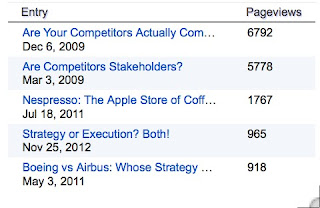
Soon I will be starting my 11th year of blogging about marketing. Looking back on my first decade, I wanted to find out which topics were the most popular.

Above, the statistics show that the most visited posts (more than 6% of the total) are about whether competitors are stakeholders.

As I say in my posts, over and over, YES. Just a few months ago, I used the airline industry as an example of why competitors are stakeholders. A year ago, I used the retail industry as an example. Competitors are stakeholders.

Other popular posts are about strategy and about Nespresso, which I called "the Apple Store of Coffee."

Thank you for reading and look for more posts on these popular topics in 2016 and beyond.

Thursday, March 24, 2016

Panera at Home Meets Consumers in Grocery Stores

Starbucks did it. Dunkin' Donuts did it. Now Panera Bread is putting branded consumer packaged products on supermarket shelves.

Panera has high brand recognition and positive associations with tasty, wholesome foods. Known in particular for fresh-baked breads and imaginative soups, Panera has adapted and packaged some of those products for retail grocery distribution, marketed through its Panera at Home division. Above, one of the packaged breads that Panera is selling through major grocery chains such as Stop & Shop.

The idea is to leverage "brand credibility" and expand beyond the restaurants into packaged goods, catering, and delivery. In today's highly competitive fast-casual restaurant industry, additional product/distribution plans are a plus for reaching more consumers and increasing revenues for the long term.

Panera also has been polishing its reputation for healthy foods by removing artificial colors and other "no nos" from its soups, including the packaged soups sold in grocery stores. This process will be complete by the end of 2016.

The firm developed a special video to explain Panera 2.0 (digital initiatives and more) to its employees and other stakeholders. You can view it here.

Thursday, March 17, 2016

Coca-Cola's Distribution Network Gets Fairlife to Local Stores

In its quest to broaden the product mix beyond carbonated soft drinks, Coca-Cola has either purchased or created popular non-soda brands like Minute Maid and Simply juices. Now it's the distribution partner of Fairlife, which produces "ultra-filtered" milk that's lactose-free and filled with protein and calcium.

Fairlife products take aim at the fast-growing niche for nutritious beverages that are convenient, tasty, and familiar. These aren't disruptive in the sense that they don't require new consumer behavior. However, they are premium and therefore the brands need to explain their benefits. Consumers won't pay the higher price unless they understand why Fairlife believes its products are competitively superior to traditional milk (and non-milk) products.

Fairlife needs more than a good product and persuasive, informative marketing. As one of the founders observes: "We had everything except the structure to get it to consumers in every corner of the country." The partnership with Coca-Cola gives Fairlife access to the beverage giant's well-developed distribution network, so consumers will find the product in their local stores.

Consumption of traditional milk products has been slowing, but specialty milk products are on the rise. Fairlife's widespread distribution gives it a fighting chance to capture a goodly portion of the ever-larger consumer appetite for specialty milks that deliver both more (better nutrition, for instance) and less (no lactose, little fat, etc).

Wednesday, March 9, 2016

Marketing with Segment Personas

Walmart Canada's marketers know they're not trying to attract everybody, but targeting specific segments whose needs, wants, and preferences they can profitably satisfy.

A segment persona is a realistic yet fictitious profile representing how a buyer in the targeted segment would typically behave, think, feel, and react to marketing activities. Creating a persona helps marketing personnel to look beyond stereotypes and understand what drives the targeted segment--insights that are so valuable when planning marketing outreach to specific segments rather than a more anonymous "mass market."

Walmart recently decided to target women with young families. As part of the targeting process, it developed a segment persona to represent this consumer--someone who, research shows, perceives costs in the value equation in terms of money, time, and effort, not just purchase price.

Naturally, Walmart's marketers quickly realized they needed to update the persona to account for major life events. When women in this segment have a baby, for example, they tend to be even more careful about how they spend their time, money, and effort. Walmart may be known for low prices, but it's also trying to position itself as helpful to this segment by making shopping less time-consuming and effortful.

Above, an image from Walmart's Live Better e-mail newsletter, which offers advice and ideas for the target audience. The main Walmart message of low prices is making headway in Canada, where its sales are up amidst economic uncertainty. Even the average revenue from a single shopping cart is up. With an eye toward shoppers who prefer organic foods, Walmart Canada is now carrying own-brand organic products.

Segment personas work in B2B marketing, as well. Dun & Bradstreet sees chief marketing officers as a key customer segment, and it creates personas to help it understand what this segment wants in the way of content marketing.

I wrote about Lululemon's use of segment personas here. For more about segment personas, see this MarketingLand article and this ClickZ article.
Monday, March 7, 2016

Marketing Earth Hour, March 19

The first Earth Hour was observed in Sydney in 2007. Then, as now, the objective is to focus attention on environmental protection of our planet's precious natural resources.

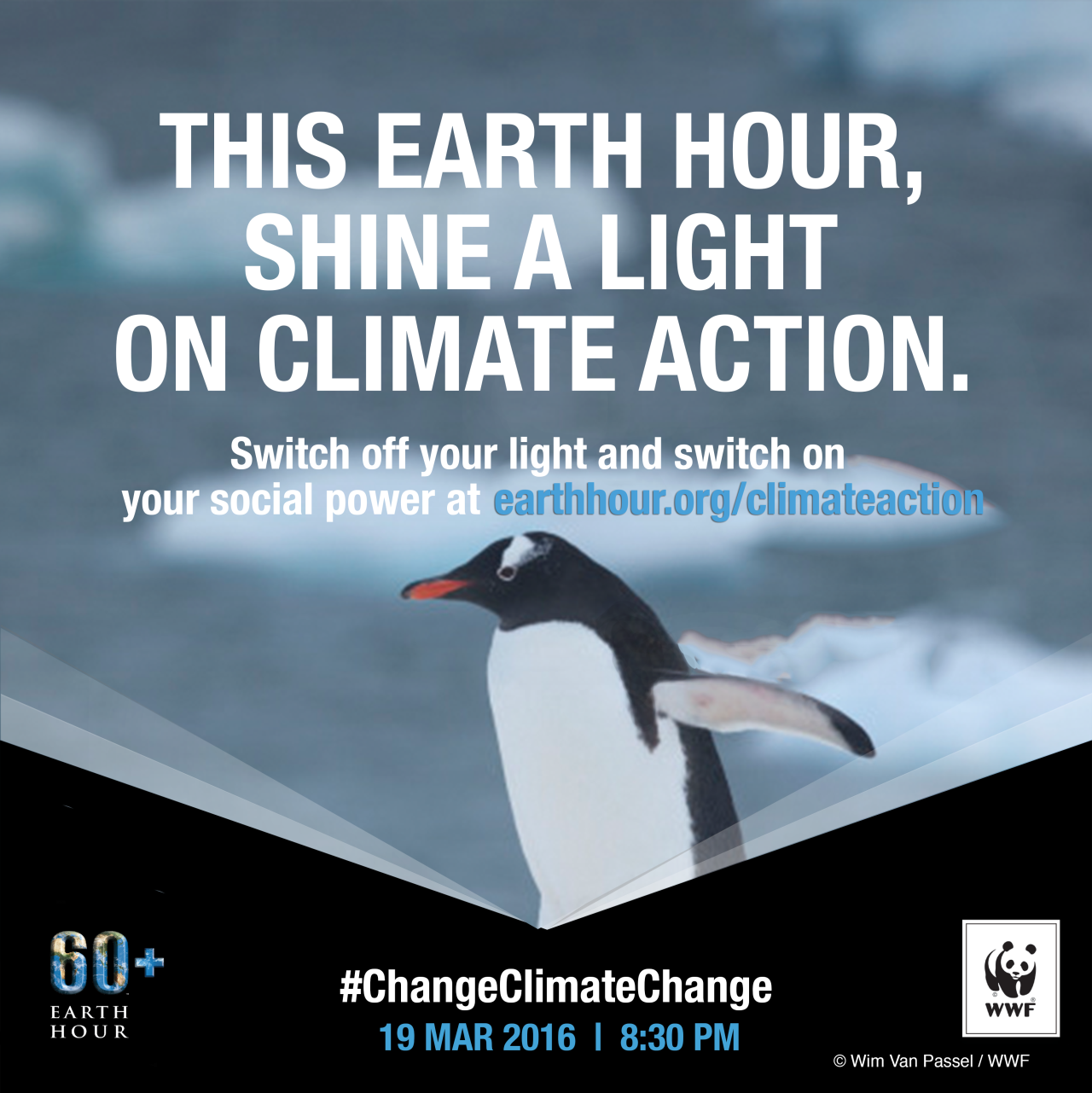
This year's Earth Hour will be 8:30 pm to 9:30 pm on March 19th. The World Wildlife Fund is marketing Earth Hour through traditional media (such as print magazine ads and YouTube-ready commercials), combined with integrated social media marketing for earned media.

Social media activities include:
  • Tumblr posts with striking images and hashtags ready for sharing, such as #ChangeClimateChange.
  • Facebook posts (1 million likes) with hashtags like #WorldWildlife
  • Instagram images (30k followers) of flora and fauna and people participating in activities to protect the planet.
  • Twitter posts (145k followers) with hashtags like #EarthHour 
  • Pinterest pins with many of the same colorful images that celebrate natural beauty and inspire participation in Earth Hour

Thursday, March 3, 2016

Mickey or Harry @ Peak Time = Surge Pricing

If it's good enough for Uber and Major League Baseball, not to mention the world's airlines, it's good enough for Disney and Universal Studios: Surge pricing comes to theme parks.

Disney announced via blog that its parks are raising one-day prices by as much as 20% during seasonal periods of peak demand. An excerpt from the blog post: "Each month is divided into value, regular and peak days with an 8-11 month calendar available for viewing online. Here’s an example, if guests plan their visit for September, they’ll have a variety of options, including many days in the value period, which will give them the opportunity to pay less for a 1-Day ticket."  

The idea of using pricing to manage demand is a basic economic principle. Movie theaters have done it for years, charging low prices for daytime movies and higher prices for evening movies. Some customer segments are willing to switch from peak to non-peak visits to save money, which frees up availability for peak visitors who can't come at other times. And that's why visiting Mickey Mouse will cost more during, say, periods when schools are on vacation and families have a few days to visit a Disney theme park. At Disney, days when demand is lowest are non-weekends, so many one-day passes for Monday-Thursday visits are "value price." Weekends are generally "regular price" and holidays are often "peak price."

Universal Studios in Orlando previously announced its use of surge pricing to manage demand this year. Its Harry Potter attractions are expected to draw crowds, and the new peak-period pricing is one way to spread out demand.

Sure, airlines have used demand-based pricing to set prices for years. That's why one passenger might pay $120 while a second passenger might pay $140 (or more) for a seat on the same plane. It's a matter of supply and demand. If there's no way to increase supply, marketers have to manage demand--and pricing is an effective way of doing just that.

Thursday, February 25, 2016

Alamo Drafthouse Promotes the Movie Experience

Austin-based Alamo Drafthouse has a movie for every taste and a tasty menu for nearly every taste. The chain, which has 22 theaters and aims for 50 within two years, keeps customers coming back by devising special drinks/foods and contests to complement the movies it shows--the latest hits and classics as well. Customizing by market, by movie, and by occasion helps the company differentiate itself and appeal to movie-lovers who want a different movie experience.

In fact, Alamo's approach to cinema-friendly food (well beyond the usual popcorn and soda pop) earns it reviews in many markets. The food and the movies are tailored to each market, making this not-a-cookie-cutter chain that thinks and acts local. Alamo has even been honored by PETA for its vegan-friendly food.

At Oscar time, Alamo runs a chainwide promotion inviting customers to vote for their Oscar favorites. It releases the results on the night the awards are given out, with prizes for customers who guess correctly.

One rule enforced by every Alamo theater is: No talking or texting during the movie, period. Above, the "don't talk" announcement that airs in Alamo theaters before movies begin. Alamo doesn't even bombard viewers with the usual 5-8 previews ahead of the feature. Instead, it customizes preshow content for its customers. And it has a rewards program that grants every member at least 3 free movie admissions per year, building goodwill and encouraging loyalty.

Sunday, February 21, 2016

Crowdsourcing for Marketing

In recent years, one of the highest profile crowdsourcing platforms for consumer products was Quirky. Now the site is under new management, and its platform is being revamped and relaunched.

How else are marketers identifying new product ideas and inventions via crowdsourcing?
  • Innocentive is a site where companies, nonprofits, and government groups can "challenge" the public to solve specific problems that will lead to new goods or services. At left, the header for Cleveland Clinic's page on Innocentive, below which are listed a number of specific medical "methods" that the organization sought innovative ideas for. Corporations also post needs and problems for Innocentive users (from around the world) to consider and submit suggestions.  
  • Some entrepreneurs post on their sites or blogs or social media to attract crowdsourced ideas. Emily Weiss put a post on her digital beauty magazine asking readers about their ideal face wash. She received hundreds of responses and used the input to create and launch Glossier Milky Jelly Cleanser. 
  • Sir Richard Branson has hosted the entrepreneurs behind the idea-sourcing site Ideapod, where consumers can post ideas on various topics. A cross between Twitter and YouTube, Ideapod can connect companies and consumers through posts of a limited number of words and videos of a limited number of seconds.
Beyond new products, many marketers are crowdsourcing content, such as the tried-and-true contests that have resulted in memorable Super Bowl ads. For 10 years, Doritos ran its "Crash the Super Bowl" contest and put the winning ads on the air and online. This year's contest was the final one, however, with not only a huge reward but also the chance to work with director Zack Snyder on a future project.

Wednesday, February 17, 2016

What Do Companies Say About Their Mission?

Not every company has a mission statement publicly available, but most major corporations post a vision and statement of values for the world to see. Here are some samples of what big companies say about their mission, which in turn drives business strategy, marketing management, and every aspect of operations.

Procter & Gamble writes about its vision this way: Our Purpose unifies us in a common cause and growth strategy of improving more consumers’ lives in small but meaningful ways each day. It inspires P&G people to make a positive contribution every day. Our Values reflect the behaviors that shape the tone of how we work with each other and with our partners. And Our Principles articulate P&G’s unique approach to conducting work every day.

Unilever writes about its purpose and vision: Our Corporate Purpose states that to succeed requires "the highest standards of corporate behaviour towards everyone we work with, the communities we touch, and the environment on which we have an impact." Unilever is committed to supporting sustainability and providing our consumers around the world with the products they need to look good, feel good and get more out of life.

Starbucks writes about its vision: To inspire and nurture the human spirit, one person, one cup, and one neighborhood at a time. With our partners, our coffee and our customers at our core, we live these values: [culture of warmth/belonging, courage to challenge status quo, transparency and dignity, accountability]. We are performance driven, through the lens of humanity.


L.L. Bean writes about its values: The values that the company's founder, L.L. Bean, was raised to believe in were simple and deeply ingrained. Nature is something to be revered. Family ties are a priority. Being neighborly is a matter of course. And "do unto others" is not just a saying, but a way of life.

McDonald's writes about its values: Everyday all around the globe, McDonald's is putting people, processes and practices into place to make better food, more sustainable sourcing, happier people, a stronger community and a healthier planet.

PepsiCo writes about its mission: As one of the largest food and beverage companies in the world, our mission is to provide consumers around the world with delicious, affordable, convenient and complementary foods and beverages from wholesome breakfasts to healthy and fun daytime snacks and beverages to evening treats. We are committed to investing in our people, our company and the communities where we operate to help position the company for long-term, sustainable growth.

Sunday, February 14, 2016

Burger King Wants to Be Hot Dog King?

Burger King recently announced the addition of a new menu item: hot dogs, available in two variations. One is "classic" with relish and other garnishes, the other is a chili-cheese dog.

So far, the fast-food firm says its test-marketing showed customers are adding dogs to their orders, not substituting dogs for burgers or other items. "It was the biggest market test that we ever did," explains the North American BK president.

In other words, this is a top-line revenue generator, and possibly a traffic-booster (at least in the short term). Plus the dogs will be supplied by Oscar Mayer, which has to be a brand boost.

Given how few national chains offer hot dogs, Burger King may see this as a way to differentiate its menu and offer a staple item that appeals across demographic groups. But given the trend toward healthier eating, adding grilled dogs is a counter-intuitive idea that might work out because it isn't "on trend."