Being a good corporate citizen is a good way to polish any brand or company name. So many stakeholders pay attention when companies pursue social responsibility agendas.
For example, Time Warner Cable and Samsung are sponsors of the Space Shuttle Pavilion at New York's Intrepid Sea, Air, and Space Museum. Thousands of visitors see those logos and names as they enter the pavilion, adding to the goodwill of these well-known firms.
In the past, some argued against this kind of expenditure, saying that the point of corporations is to be profitable. Today, many recognize that good corporate citizenship is quite compatible with profitability goals. Remember, corporations and brands serve multiple stakeholders, not just investors.
In fact, one survey in Canada showed that people actually want corporate management to take the lead in socially-responsible actions. So when a company or brand is publicly honored for good citizenship, local residents and customers alike can feel proud of their association with it.
Marketing analysis, opinion, and links by Marian Burk Wood, author of Pearson Education's "The Marketing Plan Handbook."
Monday, July 23, 2018
Friday, July 13, 2018
Payment Trend: Cashless Restaurants
A small but growing number of U.S. restaurants are going cashless--meaning they accept only credit/debit cards or electronic payments such as Apple Pay.
Why? According to restaurant owners interviewed by Visa, the benefits are:
One disadvantage to consider is whether cashless restaurants will be unable to serve the market of people who, by choice or by economic situation, are cardless.
On the other hand, the increased popularity of Starbucks Mobile Pay, Apple Pay, Samsung Pay, and other payment apps indicates that there is a definite market of people who prefer mobile transactions.
Why? According to restaurant owners interviewed by Visa, the benefits are:
- Many Millennials prefer cashless transactions
- Handling cash takes time and costs the restaurant money
- Transactions are faster, reducing wait times
- No cash means higher security and lower risk
One disadvantage to consider is whether cashless restaurants will be unable to serve the market of people who, by choice or by economic situation, are cardless.
On the other hand, the increased popularity of Starbucks Mobile Pay, Apple Pay, Samsung Pay, and other payment apps indicates that there is a definite market of people who prefer mobile transactions.
Monday, July 9, 2018
Delta Involves Customers with Social Media
Above, Delta's official Instagram account, which invites customers to "share your travel pics" along with the hashtag #Delta. With 716k followers, and lots of stunning travel images to enthrall and inspire, the airline is encouraging two-way communication via Instagram. Note the brand logo in the header, a good way to reinforce and support other marketing efforts for synergy.
The airline's official Twitter account has nearly 1.5 million followers and 750k tweets in 11 years of participation. It announces travel alerts, promos, community activities, and more via Twitter.
Delta's official Facebook page has more than 3mm likes and lots of visually-interesting informational and promotional content, such as new designer uniform photos and new destination photos.
Delta also uses hashtags for promotional purposes. One recent promo, "Pilot Talk Sweepstakes," invites the public to enter and win a free trip to the Delta destination of their choice by spelling out the city or country using "pilot talk" alphabet ("A" is "Alpha," "B" is "Bravo," etc.). Of course #pilottalksweepstakes is the hashtag.
Monday, July 2, 2018
Creative Advertising with Benefits
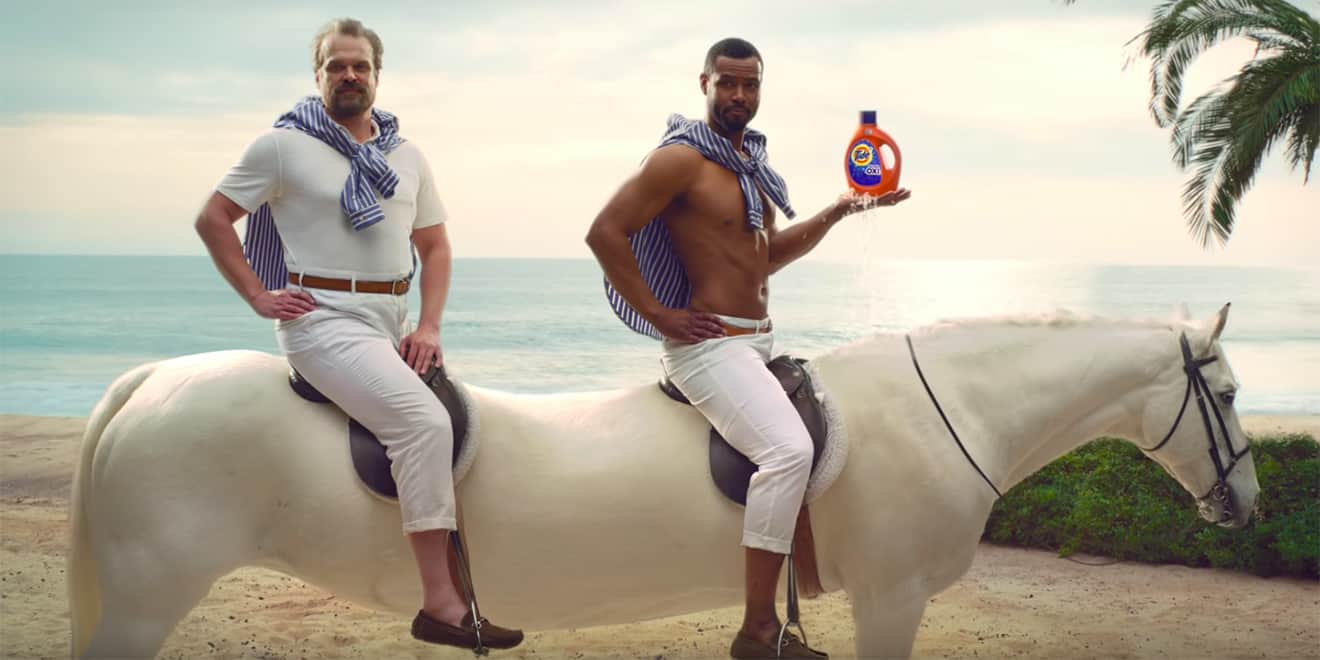
Last month, Procter & Gamble's SuperBowl campaign "It's a Tide Ad" won big at the Cannes Ad Festival. "Tide Ad is very hard-working, classic marketing but refreshed as if we were inventing that today," said one of the jurors.
If you didn't see the ad pictured above, you can see it here. Join the more than 5 million YouTube viewers who've clicked to see it.
The complete campaign is both classic and newly creative (explaining the big win at Cannes). One of the twists is that the ads appeared to be hijacking other ads during the SuperBowl until...well, the reveal is: "It's a Tide Ad." By design, the point was to have football fans and casual viewers alike look at all the commercials and wonder whether each was from Tide or a different brand.
The 2018 Tide ad spoofs P&G itself, because of the 2010 Old Spice campaign in which Isaiah Mustafa talks with the audience about "the man your man could smell like," ending the ad perched on a white horse on the beach. Now Mustafa is back, on that white horse, helping to reveal that the new ad is for Tide.
Along the way, the Tide ad shows benefits like clean clothes. Too often, today's commercials are so cleverly creative that actual benefits are missing. Not at P&G. The benefits are definitely part of the creative message.
If you didn't see the ad pictured above, you can see it here. Join the more than 5 million YouTube viewers who've clicked to see it.
The complete campaign is both classic and newly creative (explaining the big win at Cannes). One of the twists is that the ads appeared to be hijacking other ads during the SuperBowl until...well, the reveal is: "It's a Tide Ad." By design, the point was to have football fans and casual viewers alike look at all the commercials and wonder whether each was from Tide or a different brand.
The 2018 Tide ad spoofs P&G itself, because of the 2010 Old Spice campaign in which Isaiah Mustafa talks with the audience about "the man your man could smell like," ending the ad perched on a white horse on the beach. Now Mustafa is back, on that white horse, helping to reveal that the new ad is for Tide.
Along the way, the Tide ad shows benefits like clean clothes. Too often, today's commercials are so cleverly creative that actual benefits are missing. Not at P&G. The benefits are definitely part of the creative message.
Tuesday, June 19, 2018
Ocado Technology Crosses the Pond
| Image from Ocado Group's website |
The company has developed a highly efficient warehouse system that uses robots to pick and pack. See it in operation here.
Now the US supermarket chain Kroger has an exclusive deal with Ocado to build a series of robotic grocery warehouses across America. Ocado's technology will also help Kroger with delivery logistics, a key element.
Currently, Walmart dominates the US grocery business . . . and Amazon's acquisition of Whole Foods Markets turned up the competitive heat last year.
In the long run, Kroger wants to drive down costs and increase efficiency and customer service by transitioning to Ocado's system. Ocado's CEO says the deal with Kroger will "reshape the food retailing industry in the U.S. in the years to come." Meanwhile, how will consumer behavior shape the industry and competition among grocery retailers, online and in stores?
Monday, June 11, 2018
Hummus Market Is Humming
Hummus is having its turn in the marketing spotlight. Above, only part of the hummus display at a Wegmans supermarket in Virginia. In addition to the store's private-label hummus (at top right), other national and regional brands are featured.
One of the featured brands is Ithaca, named for a city in upstate New York, where Wegmans got its start. Smart marketing move to give Ithaca chainwide distribution on the East Coast rather than confining it to New York. Variety-seeking consumers and dedicated hummus-lovers outside of NY will see this unfamiliar brand, check out its unique attributes, and give it a try.
In the overall U.S. market, Sabra is the dominant brand, a market-leading position it's held for years. It's growing rapidly and expanding its R&D and manufacturing to keep up with high demand.
Wegmans carries Sabra, of course. But the diverse brands in each of its stores help to differentiate Wegmans from national supermarket chains, encouraging shoppers to return for unique and interesting choices. For the hummus brands, the marketing objective in this competitive marketplace is to secure distribution, raise brand awareness, and reinforce brand loyalty.
Note: This is post #1200 for my Marketing Handbook Blog.
One of the featured brands is Ithaca, named for a city in upstate New York, where Wegmans got its start. Smart marketing move to give Ithaca chainwide distribution on the East Coast rather than confining it to New York. Variety-seeking consumers and dedicated hummus-lovers outside of NY will see this unfamiliar brand, check out its unique attributes, and give it a try.
In the overall U.S. market, Sabra is the dominant brand, a market-leading position it's held for years. It's growing rapidly and expanding its R&D and manufacturing to keep up with high demand.
Wegmans carries Sabra, of course. But the diverse brands in each of its stores help to differentiate Wegmans from national supermarket chains, encouraging shoppers to return for unique and interesting choices. For the hummus brands, the marketing objective in this competitive marketplace is to secure distribution, raise brand awareness, and reinforce brand loyalty.
Note: This is post #1200 for my Marketing Handbook Blog.
Labels:
competition,
grocery retailing,
hummus,
Ithaca,
private brand,
private label,
retailing,
Sabra,
Wegmans
Monday, June 4, 2018
Macy's Fine-Tunes Store Retailing
Macy's is still attracting in-person shoppers, despite the incredible growth of online and mobile shopping, all competing for the attention of customers. Among the innovations it's using to draw shoppers into stores is its outlet-style retail section, known as Backstage.
In my local Macy's, Backstage occupies an area on the lower level, with its own cashiers and decor. Customers can register for text messages about new products, in-store events, and other Backstage specials. This retail brand has its own Instagram account, Facebook page, and Twitter account.
Backstage is largely stocked with "off-price" merchandise, often new products purchased out of season or as excess inventory. Mostly apparel, but also home goods, brand-name cosmetics, and lots of shoes.
What caught my eye was the above sign in the handbag department, sitting on top of a showcase featuring "previously loved" merchandise. Turns out these are high-end purses that have been repaired and are now marketed at discounted prices compared with the original new-product price.
One strategy Macy's is using to fine-tune its store retailing is "Growth 50." This involves testing a concept in 50 stores, assessing the lessons learned, and applying the most effective ideas to hundreds of other stores. Watch for more innovations and lessons learned as Macy's reinforces customer loyalty in this age of omnichannel retailing.
In my local Macy's, Backstage occupies an area on the lower level, with its own cashiers and decor. Customers can register for text messages about new products, in-store events, and other Backstage specials. This retail brand has its own Instagram account, Facebook page, and Twitter account.
Backstage is largely stocked with "off-price" merchandise, often new products purchased out of season or as excess inventory. Mostly apparel, but also home goods, brand-name cosmetics, and lots of shoes.
What caught my eye was the above sign in the handbag department, sitting on top of a showcase featuring "previously loved" merchandise. Turns out these are high-end purses that have been repaired and are now marketed at discounted prices compared with the original new-product price.
One strategy Macy's is using to fine-tune its store retailing is "Growth 50." This involves testing a concept in 50 stores, assessing the lessons learned, and applying the most effective ideas to hundreds of other stores. Watch for more innovations and lessons learned as Macy's reinforces customer loyalty in this age of omnichannel retailing.
Friday, June 1, 2018
Pepsi and "Performance with Purpose"
Just a few days ago, it acquired Bare Snacks Inc., which markets Carrot Chips, Apple Chips, and other crunchy snacks made from fruits and veggies. This acquisition expands the pantry of "good for you" products.
| http://www.nutritiongreenhouse.com/ |
PepsiCo is also using a "brand incubator" to encourage small businesses to pursue "good for you" food and beverage innovation. In addition to money, the entrepreneurial brands enrolled in the Nutrition Greenhouse incubator receive mentoring to grow their businesses.
Wednesday, May 23, 2018
Yogurt, yogurt everywhere
Walk into any supermarket or health-foods store today, and you'll see a vast array of yogurts in the dairy case. Flash back just 11 years, and the yogurt offerings were meager, to say the least. Dannon was marketing yogurt in US stores, but the food category was miniscule and anything but mainstream.
The incredible growth of yogurt during the 21st century is due, in large part, to the entrance of one brand--Chobani, which launched its Greek yogurt in 2007.
Today, Chobani is competing with brands that didn't exist in 2007, as well as brand and product extensions of companies that were part of the yogurt market in the 20th century. Consumers have responded to the new wave of yogurts by trying new products and, in some cases, becoming loyal yogurt lovers.
No wonder Chobani has been redesigning its products and packaging to stand out in this increasingly crowded environment. The company is also reformulating yogurts with lower sugar and more flavor pop. And it's "stretching" the branded yogurt concept into drinkable products, among other innovations.
Yogurt is everywhere. How will Chobani, Dannon, and other brands maintain the interest and loyalty of consumers in such a competitive marketplace?
The incredible growth of yogurt during the 21st century is due, in large part, to the entrance of one brand--Chobani, which launched its Greek yogurt in 2007.
Today, Chobani is competing with brands that didn't exist in 2007, as well as brand and product extensions of companies that were part of the yogurt market in the 20th century. Consumers have responded to the new wave of yogurts by trying new products and, in some cases, becoming loyal yogurt lovers.
No wonder Chobani has been redesigning its products and packaging to stand out in this increasingly crowded environment. The company is also reformulating yogurts with lower sugar and more flavor pop. And it's "stretching" the branded yogurt concept into drinkable products, among other innovations.
Yogurt is everywhere. How will Chobani, Dannon, and other brands maintain the interest and loyalty of consumers in such a competitive marketplace?
Sunday, May 20, 2018
The Sneakerization of the Non-Dairy Milk Market
Does the "dairy case" in your local supermarket include rows of shelves with alternatives like soy milk and almond milk?
The increase in number and variety of non-dairy milk products illustrates the "sneakerization" of this market--meaning the proliferation of multiple products for microtargeting niche or microniche consumer segments. Ever-finer market segmentation for targeting small niches interested in specific types of products/benefits, in other words.
Even calling these products "___milk" can be controversial. But despite industry efforts like the long-running "Got Milk?" campaign (which morphed into "Milk Life"), consumption of traditional dairy milk is not going up.
In fact, many consumers are seeking out milk alternatives for health, nutrition, and lifestyle reasons.
Consumers are paying attention to these non-dairy milks and seeking out new choices, boosting demand for what was once a tiny niche. This is changing the makeup of the industry. For instance, adapting to this trend toward proliferation of non-milk products, one former dairy producer now makes peanut milk.
Sneakerization of this market means more competition among non-dairy milk products AND milk products, all seeking to improve market share, sales, and profitability.
The increase in number and variety of non-dairy milk products illustrates the "sneakerization" of this market--meaning the proliferation of multiple products for microtargeting niche or microniche consumer segments. Ever-finer market segmentation for targeting small niches interested in specific types of products/benefits, in other words.
Even calling these products "___milk" can be controversial. But despite industry efforts like the long-running "Got Milk?" campaign (which morphed into "Milk Life"), consumption of traditional dairy milk is not going up.
In fact, many consumers are seeking out milk alternatives for health, nutrition, and lifestyle reasons.
Consumers are paying attention to these non-dairy milks and seeking out new choices, boosting demand for what was once a tiny niche. This is changing the makeup of the industry. For instance, adapting to this trend toward proliferation of non-milk products, one former dairy producer now makes peanut milk.
Sneakerization of this market means more competition among non-dairy milk products AND milk products, all seeking to improve market share, sales, and profitability.