This is the time of year when Fortune publishes its door-stop-sized issue listing America's 500 largest corporations. Since 1998, I've tracked the number of pages per issue, which is suggestive of the economic situation because of the number of ads and, therefore, the size of the issue.
The 2016 issue, alas, is not as fat as 2015, 2014, or 2013, going by the numbered pages. It's only 10 pages bigger than the 2008 issue, which came out in the year of the financial crisis. But then again, this is an election year, which may affect advertising decisions and budgets.
Another major factor is the increase in digital advertising, which is partly responsible for the plateau (at best) or decline in print advertising overall.
2016: 346
2015: 392
2014: 390
2013: 352
2012: 312
2011: 316
2010: 308
2009: 276
2008: 356
2007: 386
2006: 384
2005: 410
2004: 478
2003: 410
2002: 402
2001: 474
2000: 630 - Peak of dot-com boom!
1999: 510
1998: 506
Wednesday, June 15, 2016

Monday, June 13, 2016
A Closer Look at LEGO Serious Play
 |
| From LEGO Serious Play |
LEGO isn't the only big name in children's entertainment to offer corporate programs. Walt Disney has a separate division to teach customer service skills and support service teambuilding. It also offers unique team-building opportunities for groups that meet at its hotels and resorts.
LEGO's division is marketing teambuilding activities built around using LEGO blocks to create structures - and, in the process, inject more creativity into working together.
Quoting from the LEGO Serious Play site: The metaphors in the models serve as the basis for group discussion, knowledge sharing and problem solving and help foster creative thinking and finding unique solutions. The idea originated in 1996 and LEGO Serious Play has now certified facilitators all over the world.
There's a book about this teamwork/creativity approach, in case your management wants to try this at home. The Chicago Tribune wrote about LEGO Serious Play in 2015, interviewing one of the book's authors. Others are using LEGO toys to unlock creative potential, as shown on this page about LEGO and Art Lab. And some companies ask job candidates to build LEGO structures during the recruitment process--so be prepared. These ubiquitous plastic bricks have value to people of all ages and at all levels!
Monday, June 6, 2016
Joe Fresh Leaves America

By 2015, Joe Fresh was in only 200 Penney stores but pushing multichannel marketing for US customers. Now Joe Fresh is closing its flagship US stores and its US deal with JC Penney is over.
Will the brand try America again? US customers can still shop online or cross the border to a freestanding Joe Fresh store or a store inside/next to a Loblaw's across Canada.
The brand, owned by Loblaw's, uses social and digital media to reach fans of cheap chic fashion. Its FB page has 266,000 likes, its Twitter feed has 94,000 followers, its Snapchat account is @JoeFreshSnaps, and its Pinterest boards have 14,000 followers. It has an app with special deals and a blog for content marketing.
Friday, June 3, 2016
Are Department Stores Dinosaurs?

During the 1980s and 1990s, department stores and mass merchandisers were making significant changes behind the scenes. Point-of-sale terminals replaced cash registers, and personal computers brought data analysis to management's fingertips. Managers could see hourly sales trends instead of waiting for end-of-month numbers.
In those days, department stores like Saks and Sears still offered private-label credit cards, which in turn allowed them to see who bought what and how often. Credit was frequently a source of profits, not just an engine for supporting sales increases. (Today, nearly all store cards are operated by non-retailers). Remember, Sears founded the Discover card, using its expertise in the credit industry. Here's a case study about Sears that offers clues to some of the retail challenges of the time. And here's a quick look at how Sears evolved over the years.
The question of whether department stores are dinosaurs bound for extinction is still being asked. A real estate analysis firm recently estimated that department stores would need to shutter hundreds of branches to return to the sales-per-square-foot productivity levels of 2006. That translates into a sea of empty anchor stores all over the country. Malls are trying to update the shopping experience to bring consumers back, to go to the movies or for specialty stores that are especially in demand.
In a world where promotional pricing attracts shopper attention, department stores are joining in, and that's making waves for high-end brands. Michael Kors is going to limit the number of products it sells to department stores to avoid having its lux image affected by promo pricing.
Department stores are also making some other adjustments. Macy's is closing a few dozen stores, and Sears/Kmart is closing some stores as well. Macy's has begun rolling out "Backstage" off-price stores within stores to utilize space and attract price-conscious shoppers who might otherwise go elsewhere. Sears is leasing some of its space to other stores, such as Primark.
It's still too early to deem department stores dinosaurs.
Sunday, May 29, 2016
Brand Rankings in 2016
So many ways to rank brands! Some authorities rank on the basis of brand value, some on the basis of performance, and on and on. In Fortune's recent listing of world's most admired companies, the top three were well-known US brands:
Here's a selection of how other sites rank US brands of various sorts.
- Apple
- Alphabet (you know, Google's parent)
- Amazon

Here's a selection of how other sites rank US brands of various sorts.
Thursday, May 19, 2016
Mobile Payments Inch Toward Wider Usage
This contactless payment trend has the potential to dramatically change how consumers behave in purchase situations--but that's only a potential outcome. Currently, mobile payments do not yet have the most compelling reasons to change consumer behavior, even though mobile banking is very popular.
Here are some of the latest developments as mobile payments inch along:
- Android Pay will now be accepted for purchases on websites and for ATM transactions.
- FitBit is planning to include payment functionality on future fitness tracking products.
- Apple Pay is expanding in Canada with the acceptance by major banks there.
- Samsung Pay is widely accepted among US retailers and is partnering with Alibaba for the Chinese market.
- Walmart has introduced its payment app in Texas.
Friday, May 13, 2016
Neuroscience Helps Advertisers Connect with Audiences
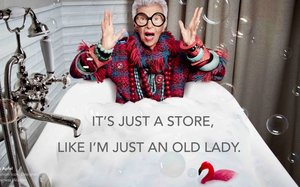
For example:
- Print ads can stick in the memory because of the involvement in recognizing, comprehending, and processing words and symbols.
- Ads with emotional content are much more effective than those without.
- Ads embedded in mobile entertainment shouldn't interrupt the game before an important play.
- Ad content should connect with the audience's objectives.
The store is Pirch, and the "old lady" is Iris Apfel, known for her distinctive sense of style. The CMO says, "We looked at this campaign from the approach of explaining and establishing Pirch as a lifestyle, experiential brand." An interesting ad that puts a different spin on "experiential" to attract attention.
Monday, May 9, 2016
Selfies as Self-Ethnographic Research

Audi used ethnographic research in Australia to better understand the context of the local car-buying situation and used that research to inform the development of segment personas. As a result, Audi now has a series of brand touchpoints it has mapped and can target with marketing objectives for each contact. General Motors had ethnographic research and personas, but it needed to add emotion to the equation in order to make sense out of the data and apply the results to a marketing strategy.
Selfies are the next frontier in ethnographic research, with consumers using an app to snap and upload photos showing a product or process in use. Crest has used selfies collected by Pay Your Selfie to better understand when people brush their teeth. Based on the selfie research, Crest's marketers learned about a spike in brushing before dinner--perhaps related to a desire for fresh-smelling breath before happy hour?
One startup, Pay Your Selfie, allows marketers to go where they rarely have access, inside the consumer's real life. Rather than ask someone to describe what they do, a selfie shows the consumer interacting with a brand or product. An ad agency exec for Leo Burnett notes: "From a research perspective, we often ask people to describe what their morning is like in surveys. But a quick picture of their table would definitely be worth 1,000 words."
Selfie-takers get a small amount of money for each "task" they complete, such as snapping a selfie while brushing their teeth. Clearly, the sample for these research studies is limited and self-selecting. But the possibility of stepping into the consumer's world is very intriguing and can yield insights for future marketing plans. Pay Your Selfie is also into political research. Self-ethnographic research is still in its infancy. What next?
Tuesday, May 3, 2016
Thinking About Digital Devices and "Dayparts"
Think with Google just posted a fascinating discussion about "dayparting" and targeting. The main idea is that marketers should analyze "micro-moment" opportunities for communicating with the target market, when and where and how these consumers are accessing data. How--meaning what type of digital device people are using at the time.
This isn't Google's first post about micro-moments. Last year, a post discussed how consumer behavior is shifting and now comprises so many split-second decisions and actions such as checking social media, checking a bank balance or texting a friend. At those moments, consumers may use different digital devices and want different info or products or functionality. Marketers, are you ready?

Pew Research points out (above) that Millennials are almost all tethered to their cell or smartphones--and some simply see no need for certain other digital devices. That's bad news for PC/Mac makers, bad news for marketers of e-book readers, bad news for game console marketers. It's also a wakeup call for marketers that think about websites and social media in terms of the big screen and in terms of one message all the time.
Mapping the dayparts of digital involvement, Google has found that many people use their phones to accomplish things on the way to work and after the work day is over. During business hours, more tablets and computers are used for online searches, compared with the number of searches by phone.
Understanding consumer behavior and micro-moments will help you plan marketing that makes sense for consumers and the digital device they're using at that time, the content they're seeking, and the functionality you should have for big or tiny screens. Is your marketing plan in tune with these micro-moments?
This isn't Google's first post about micro-moments. Last year, a post discussed how consumer behavior is shifting and now comprises so many split-second decisions and actions such as checking social media, checking a bank balance or texting a friend. At those moments, consumers may use different digital devices and want different info or products or functionality. Marketers, are you ready?

Pew Research points out (above) that Millennials are almost all tethered to their cell or smartphones--and some simply see no need for certain other digital devices. That's bad news for PC/Mac makers, bad news for marketers of e-book readers, bad news for game console marketers. It's also a wakeup call for marketers that think about websites and social media in terms of the big screen and in terms of one message all the time.
Mapping the dayparts of digital involvement, Google has found that many people use their phones to accomplish things on the way to work and after the work day is over. During business hours, more tablets and computers are used for online searches, compared with the number of searches by phone.
Understanding consumer behavior and micro-moments will help you plan marketing that makes sense for consumers and the digital device they're using at that time, the content they're seeking, and the functionality you should have for big or tiny screens. Is your marketing plan in tune with these micro-moments?
Monday, May 2, 2016
Cruising into History: Marketing Cruises to Cuba

Fathom sails to other destinations, and its unique selling proposition (remember that buzzword of the last century?) is that passengers can choose to participate in volunteer projects. In the Dominican Republic, for example, passengers can help school children practice their English or work for a few hours on water filters, among other possibilities.
A report last month said Royal Caribbean will base one of its ships (Empress of the Seas) in Havana. Royal Caribbean can promote its Cuban trips and also carry passengers to Caribbean destinations from there.
Permission from the Cuban is needed before cruise ships can dock in Havana or other Cuban ports, but the process is far from routine or speedy, as Pearl Seas Cruises learned. Pearl had to cancel its first 10-day cruise to Cuba after failing to receive permission on time.
Expect more cruises to and from Cuba as the government acts on applications and demand increases.